
Key takeaways
CPQ brings rules to configuration, pricing and quoting. AI adds the part no rule set covers: the unstructured request before it and the check after it. Genow is not a CPQ system; it works before and after one and makes an existing CPQ more effective.
- CPQ stands for Configure, Price, Quote. CPQ software checks variants against technical rules, applies pricing logic and produces a quote document from the result.
- In technical sales, most of the time is lost before the CPQ: reading specifications, structuring requirements, finding the right product. A CPQ assumes that work is already done.
- 70 to 80 % of the answers to a tender already sit in earlier proposals. AI finds them, backs every statement with a source and turns them into a draft.
- CPQ with AI does not replace an existing CPQ. The AI supplies a valid starting point and checks the result; the CPQ stays in charge of rules and prices.
- Starting without a CPQ works too: the AI works directly on data sheets, option data, price lists and past proposals.
Table of contents
- What is CPQ?
- Why quotes in technical sales take so long
- Where classic CPQ reaches its limits
- When a CPQ is enough and when AI belongs in front of it
- What AI takes over in the quoting process
- CPQ, product configurator and AI: drawing the lines
- Manual, classic CPQ and CPQ with AI compared
- The topics of this guide in depth
- From practice: KION
- How to recognise a good CPQ solution with AI
- How to introduce CPQ with AI
- FAQ
What is CPQ?
CPQ stands for Configure, Price, Quote. It describes a software category that brings these three steps together in one system instead of spreading them across spreadsheets, PDF price lists and email threads.
- Configure: Sales picks a product and its options. The system checks whether the combination is technically valid and blocks whatever rules each other out.
- Price: List prices, surcharges, discount tiers and special terms are applied according to fixed rules.
- Quote: The validated configuration becomes a quote document in the company’s own template.
Whether people say CPQ software, a CPQ solution or a CPQ system, in practice they mean the same thing. The differences lie in the vendor and in the depth of the rule sets, not in the category. For a fuller introduction to the basics, read What is CPQ?.
For industrial companies with configurable products, CPQ is more than a price calculator. Anyone selling machines, plants, drives or components with thousands of variants needs something that knows which options fit together. Without it, that knowledge lives in the heads of a few experts in application engineering.
Why quotes in technical sales take so long
In many machine and plant builders, a complex quote takes three to six weeks. The reason is rarely the writing. The reason is the searching.
A typical request arrives as a tender with a requirements catalogue, as a 50-page specification or as an email with a handful of key figures. Before any system can configure anything, someone has to:
- read the document and pull out every requirement,
- work out which requirements are mandatory and which are nice to have,
- search the portfolio for products that meet them,
- check which variants and options are valid,
- find earlier proposals for similar cases to reuse wording, prices and references.
That work is spread across many systems. Product master data sits in the ERP, drawings in the PLM, specifications in SharePoint, past proposals as PDFs on the sales drive. The experience of which configuration has proven itself sits with a few people in application and project engineering, who answer every question one at a time. With special manufacturing, design engineering joins in and often starts from scratch, even though something very similar has been built before.
On top of that comes a finding we see in project after project: 70 to 80 % of the answers to a tender already sit in earlier proposals. The knowledge exists. It just cannot be found when it is needed. Whoever submits a solid quote first has an edge over the competition, and that is exactly the lead that gets lost in research.
Where classic CPQ reaches its limits
A CPQ system is strong once the requirement is clear. It then turns it, deterministically, into a buildable, correctly priced configuration. In technical sales, though, there are three points where it does not help.
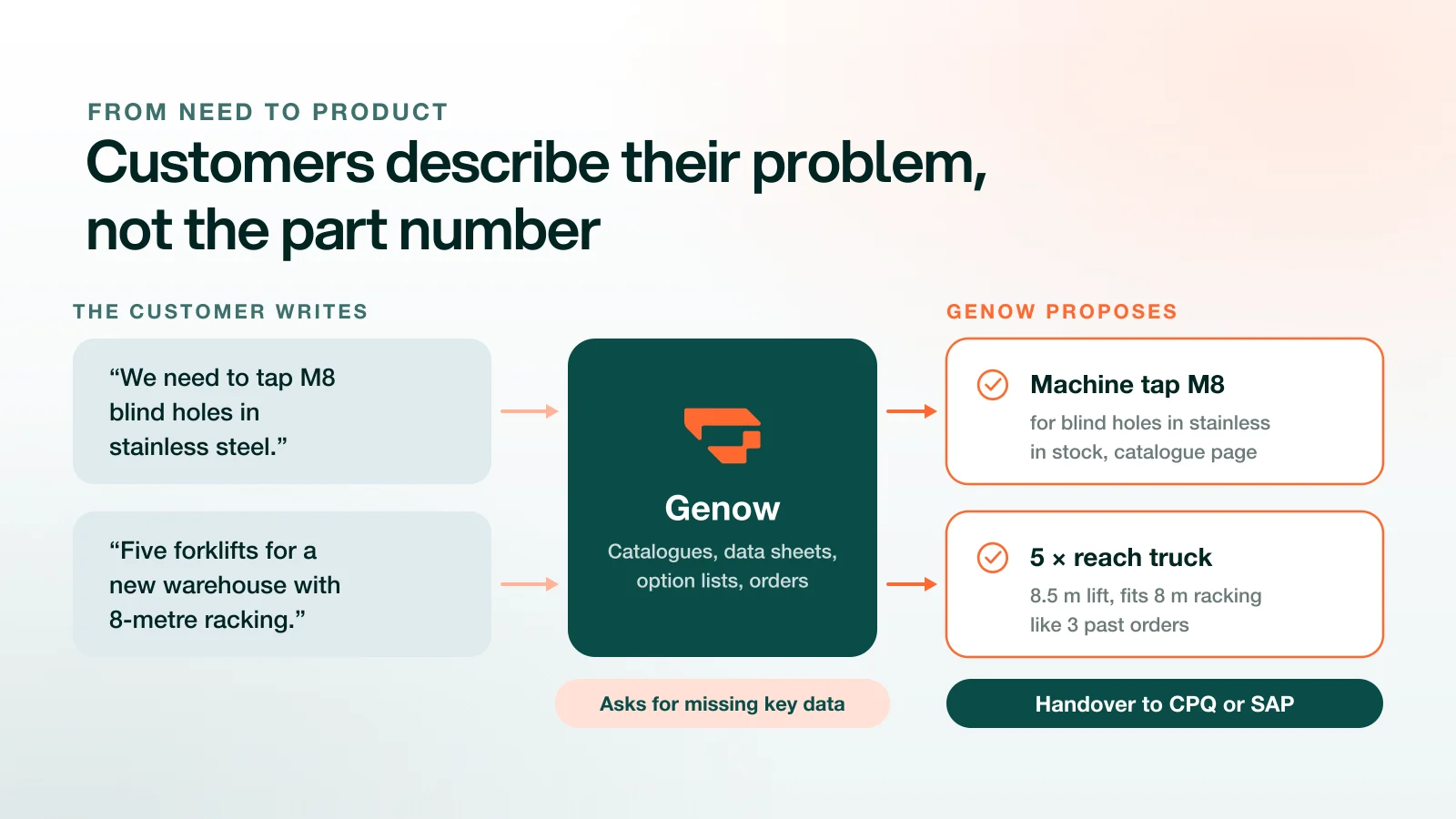
Before configuration. CPQ expects structured input: product, options, quantities. Customers, however, describe their problem, not the part number. “We need to tap M8 blind holes in stainless steel” or “Five forklifts for a new warehouse with 8-metre racking” are not configurations, they are needs. Translating the need into an input is not something the CPQ does; it stays with a person.
After configuration. CPQ prices exactly what was entered. It does not check whether another valid variant would have fitted better, whether a matching accessory is missing or whether a higher-margin option was overlooked. Nor does it check the finished quote against the specification, contract terms and factory standards. Yet a single overlooked sentence, such as a penalty of 0.5 % of order value per day of delay, can cost the entire margin.
In maintenance. Every rule set has to be built and maintained. With large portfolios and frequent product changes, maintaining the rules becomes a project of its own. Variants that are not modelled do not exist for the CPQ, even when they could be built.
None of this is a flaw in CPQ. It simply is not its job. This is where AI comes in, as a complement to the CPQ, not a replacement.
When a CPQ is enough and when AI belongs in front of it
Whether a CPQ is enough on its own depends on two questions: what does the customer send, and what does it take to answer? The further an inquiry is from the catalogue, the more work sits in front of the CPQ.
| What the customer sends | What the answer takes | Is a CPQ enough? | Where AI helps in front |
|---|---|---|---|
| Part number and quantity | Catalogue or stock item | Yes, or the ERP directly | Read the inquiry from email or Excel, check price and stock, draft the reply |
| A competitor’s part number | Matching item from your range | Only after the match | Map the competitor item to your own range, with reasoning |
| Application and key data | Product from the modular system, or a variant | Only once the product is fixed | Translate the requirement into product and options, hand over to CPQ or SAP |
| Problem, goal or specification | Variant or special manufacturing | Only for the parts already fixed | Capture requirements, find similar past orders, give design engineering a complete brief |
The top row is routine for a CPQ. The lower rows are where most of the effort sits, and where quotes lose days or weeks.
What AI takes over in the quoting process
CPQ with AI means the AI takes over the steps that today sit between the customer request and the CPQ, and between the CPQ and sending the quote. In Genow, the AI Workspace for industrial sales, this runs as one continuous flow. There is one chat, and the workspace decides which specialist takes each request.
- Read the request. The tender, specification or email is read in, and every requirement is captured individually and marked as mandatory or optional.
- Structure the requirements. Free text becomes an ordered list with values, units and standards. Where something is missing, the result is a targeted question to the customer, not an assumption.
- Find the product. The requirements are checked against data sheets, option data and validity rules. The result is a match that is valid, buildable and justified, including from product series sales rarely offers.
- Hand over to CPQ or SAP. The valid starting point goes to the CPQ or straight into SAP. Rules and prices stay there.
- Draft the quote. Earlier, won proposals supply wording, references and an answer to every single requirement, in the company template and with a source for each statement.
- Cross-check. Before sending, the draft is laid against the specification, contract terms and factory standards. Instead of 340 pages, the experts review a handful of findings: a penalty clause that is not priced, a factory standard that is not met, an acceptance test missing from the scope, a price below similar projects. Every finding points to its passage in the document.
The decisive difference from a general AI chat: every statement in the draft has a source that sales can open. The AI does not invent technical values; it finds and connects what the company has already documented. That is made possible by the Genow Context Engine, which knows each company’s product hierarchies, terminology and document relationships.
Steps 1, 2, 5 and 6 are covered in detail on the page on AI-assisted proposal writing, steps 3 and 4 on the page on AI-assisted product configuration.
CPQ, product configurator and AI: drawing the lines
The market often blurs three terms. Separating them cleanly helps with every buying decision.
- A product configurator checks which variants and options technically fit together. It is the rule set.
- A CPQ system builds on a configurator and adds pricing logic and quote generation. Many CPQ vendors ship their own configurator.
- AI in the quoting process works with language and documents. It reads requests, finds knowledge and writes drafts. It does not replace a rule set; it feeds it clean input.
If you want to settle “CPQ or configurator?” in more detail, see CPQ vs. product configurator. If you already run Tacton or Configit, or are looking for a Tacton alternative, Before the configurator shows how Genow works in front of the CPQ and fills it with a valid starting point.
Manual, classic CPQ and CPQ with AI compared
| Criterion | Manual quoting | Classic CPQ | CPQ with AI |
|---|---|---|---|
| Incoming request | Sales reads the specification | Sales transfers requirements by hand | Requirements captured and structured automatically |
| Product selection | Individual experience | Modelled variants only | Whole portfolio, checked against rules and justified |
| Configuration | Spreadsheets and questions to application engineering | Rule-based and reliable | Rule-based in the CPQ, from a valid starting point |
| Quote text | Copied from old documents | Template with standard blocks | Draft from won proposals, a source per statement |
| Check against specification and contract | Spot checks | Not provided | Every requirement matched, risks with their passage |
| Knowledge of variants | In a few heads | In the rule set, as far as maintained | In the rule set and findable across every document |
| Effort to introduce | None | Build and maintain a rule set | On existing data, with or without a CPQ |
The topics of this guide in depth
CPQ with AI touches several tasks in technical sales. Each has its own article that goes deeper.
- How to write an RFP response with AI: When a tender is worth bidding on, and how the requirements catalogue becomes a complete draft response, with a template to copy.
- Automating quotes in machine building: How a specification becomes a proposal draft in hours, and how special requests are checked before they reach design engineering.
- CPQ vs. product configurator: Where the difference lies and which system solves which problem.
- Before the configurator: Genow vs. Tacton & Configit: Why CPQ alone does not solve the inquiry, and how Genow feeds an existing CPQ.
- Agentic guided selling: How the path from customer need to the right product works without rigid question trees.
From practice: KION
With brands such as Linde and STILL, the KION Group is one of the world’s leading suppliers of industrial trucks, warehouse technology and supply chain solutions. More than 42,000 employees, customers in over 100 countries and a portfolio no single salesperson can fully keep track of.
Today more than 1,000 users worldwide work with Genow in over seven languages. Configuration and quote preparation run twice as fast as before, and every answer is fact-based because it traces back to a source inside the company. Tim Lennard Busch, Project Manager Sales Excellence at KION, puts it this way: “The Sales Assistant delivers comprehensive answers within seconds.”
Read the full story in the KION case study.
How to recognise a good CPQ solution with AI
Many vendors now put “AI” on their CPQ. For technical sales, five questions matter, and each can be tested in a demo.
- Does it read real specifications? The test is a real, unprepared document from your company, not a curated example with tidy tables.
- Does it show its sources? Every technical statement in the draft must trace back to a data sheet, an option list or an earlier proposal. An answer without a source is a liability risk in a quote.
- Does it know your validity rules? A match that sounds right but cannot be built costs more time later than searching by hand.
- Does it work with your existing CPQ? Anyone who has already invested in a rule set wants to fill it, not replace it.
- Does it ask instead of guessing? When information is missing, a targeted question to the customer or application engineering is the right result, not a plausible assumption.
A vendor who shows these points on your own documents has proven more than any architecture slide.
How to introduce CPQ with AI
An AI approach to quoting needs neither a new rule set nor a multi-year IT project. This order has proven itself:
- Pick one bottleneck. Usually it is answering tenders or choosing products for vague requests. A clear use case with a measurable turnaround time is the best start.
- Connect the data you have. Data sheets, option data, price lists and a selection of won proposals are enough to begin. A CPQ can come later.
- Test with real requests. Experienced colleagues from inside sales and application engineering review the drafts on real specifications and give feedback. This shows where knowledge is missing.
- Measure. Turnaround per quote, the number of questions to application engineering and hit rate are the three figures that prove the value.
- Expand. Further product lines, regions and the connection to CPQ and CRM follow once the first use case holds.
Genow runs hosted in the EU or in your own cloud. No model is trained on your data, and access rights are inherited from the source systems. More on the Security & Compliance page.
FAQ
What does CPQ mean?
CPQ stands for Configure, Price, Quote. CPQ software combines product configuration, pricing logic and quote generation in one system so that complex quotes come out rule-compliant and correctly priced.
What is the difference between CPQ software, a CPQ solution and a CPQ system?
In practice, none. All three terms describe the same category. The differences between vendors lie in the depth of the configurator, the pricing logic and the connection to CRM and ERP.
Does AI replace an existing CPQ?
No. The AI takes over the work before and after the CPQ: reading requests, structuring requirements, finding the right product and checking the finished quote against the request. Rules and prices stay in the CPQ.
Do we need a CPQ before using AI in quoting?
No. Many companies start without a CPQ, working directly on data sheets, option data, price lists and earlier proposals. A CPQ can be connected later and strengthens the effect.
Is CPQ with AI just a chatbot?
No. A chatbot writes text. CPQ with AI checks requirements against product rules, finds buildable variants and backs every statement in the draft quote with a source from inside the company.
Is AI in quoting GDPR-compliant?
Yes, if the vendor offers EU hosting or operation in your own cloud, does not train on customer data and inherits access rights from the source systems. Genow meets all three.