What Is CPQ? Configure, Price, Quote Explained for Complex Sales
CPQ explained: how configure-price-quote software automates complex quoting, cuts errors, and frees up sales teams for selling.
Key takeaways
CPQ automates quoting for complex, configurable products — from requirement to accurate price, without manual back-and-forth.
- CPQ stands for Configure, Price, Quote — it merges product configuration, pricing logic, and quote generation into one system instead of spreadsheets and email threads.
- Without CPQ, reps lose up to 90 minutes per quote; documented CPQ deployments cut that time by as much as 96%.
- Manual configuration mistakes cost industrial companies real money — CPQ reduces quoting errors by up to 36%.
- Speed wins deals: the first vendor to respond wins up to 50% more of them.
Table of contents
- What does CPQ actually mean?
- How does a CPQ solution work?
- CPQ is not a CRM or an ERP
- Manual quoting vs. CPQ compared
- CPQ in practice: from spec sheet to quote
- How agentic AI enhances CPQ configuration
- FAQ
What does CPQ actually mean?
CPQ is a software category that unifies three steps of the quoting process — Configure, Price, Quote — into one continuous system. For industrial companies with configurable products, many variants, and technical dependencies, CPQ replaces what today often lives in the heads, spreadsheets, and email histories of individual sales engineers.
The problem CPQ solves is concretely measurable: without it, reps lose up to 90 minutes on a single complex quote — time spent on configuration logic, not on the customer conversation.
How does a CPQ solution work?
A CPQ solution typically follows this flow:
- Configure — the rep selects from valid product variants while the system automatically checks technical dependencies and exclusion rules.
- Price — pricing logic, discount rules, and special terms are applied by rule, instead of being recalculated by hand.
- Quote — a validated configuration automatically produces a correctly formatted quote document.
The effect: sales engineers and reps no longer need to pull technical expertise from memory for every request — the system already knows the rules.
CPQ is not a CRM or an ERP
CPQ is often confused with CRM or ERP, but it serves a different function. A CRM manages customer relationships and pipeline status; an ERP manages resources, inventory, and financial accounting. CPQ sits between them: it pulls product and pricing logic from the ERP, makes it usable in the sales process, and hands a clean quote back to CRM and ERP. CPQ closes the gap that opens up between them once configuration and pricing get too complex for manual handling.
Manual quoting vs. CPQ compared
| Criterion | Manual quoting | With CPQ |
|---|---|---|
| Time per quote | up to 90 minutes | minutes instead of hours |
| Configuration error rate | high, dependent on rep experience | up to 36% fewer errors |
| Product-variant knowledge | held by individual sales engineers | stored in the system, accessible to everyone |
| Response speed | depends on expert availability | immediate, regardless of who’s on shift |
| Scalability as the catalog grows | difficult, training burden increases | rules maintained centrally |
CPQ in practice: from spec sheet to quote
The value shows up clearest on technically complex tenders: a sales team receives a multi-page specification document, has to derive the right product configuration from it, and produce a quote with correct pricing — a process that traditionally required looping in engineering. The result is a rule-compliant, correctly priced quote. Whether it’s also the best quote for that specific customer is a different question — more on that below.
How agentic AI enhances CPQ configuration
A CPQ system is strong at turning an already clearly defined requirement into a buildable, correctly priced configuration, deterministically. That said, a standard CPQ system has some limitations of its own.
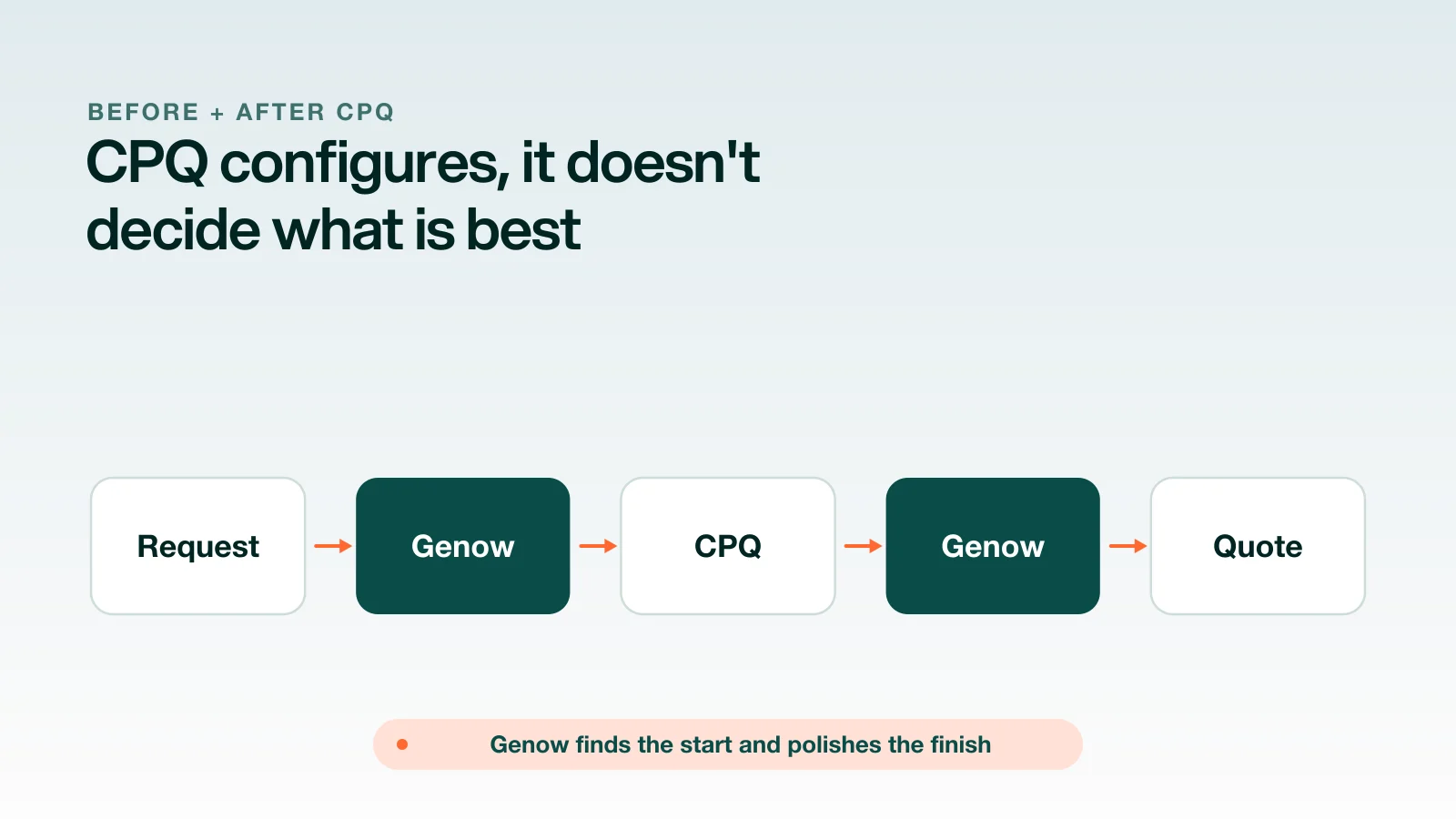
Before, CPQ assumes it’s already clear what needs to be configured. In consultative sales of complex products, though, the requirement often shows up as a need, an incomplete spec document, or a sentence in a sales conversation — unstructured, not a ready-made configuration. Genow Sales Cowork can interpret that unstructured request and guide the sales team to the right starting point, while the actual configuration stays the CPQ’s job.
After, the CPQ configures and prices exactly what was entered, but doesn’t actively check whether a different valid variant would have better matched the actual need or delivered more margin. This is where Genow Sales Cowork can step in on the finished quote: cross-checking it against the original customer requirement and the full product portfolio, surfacing discrepancies, and cleaning up and personalizing the quote — for example with the right reference or a clear rationale — before it reaches the customer.
Both roles work hand in hand with an existing CPQ: Genow Sales Cowork supplies the valid starting point and polishes the result, while the CPQ handles the configuration and pricing logic.
FAQ
What does CPQ stand for?
CPQ stands for Configure, Price, Quote — the three steps of configuration, pricing, and quote generation combined into one system.
Which companies benefit most from CPQ?
Especially industrial companies with configurable products, many variants, technical dependencies, and frequent, complex quote requests.
Does CPQ replace the sales engineer?
No. CPQ handles rule-based configuration and pricing logic so sales engineers can focus on more complex, advisory cases instead of manually processing standard requests.
How is CPQ different from a simple price calculator?
A price calculator usually only models simple pricing logic. CPQ additionally combines product configuration with technical dependencies and automated document generation.
What's the difference between CPQ and quote-to-cash?
CPQ is a sub-process within quote-to-cash, focused on configuration, pricing, and quote generation. Quote-to-cash additionally covers contract closing, order fulfillment, and invoicing.
Does CPQ require its own IT project?
Not necessarily — modern, agentic approaches can build on existing product data without first requiring a fully manually built rule set.
Why doesn't a CPQ automatically find the best quote?
Because a CPQ configures and prices the request exactly as entered — it doesn't actively compare the chosen configuration against other valid variants that might better fit the actual need or deliver more margin.
How does Genow work alongside an existing CPQ?
In two spots: before configuration, Genow helps derive the right starting point for the CPQ from an unstructured request. After configuration, Genow checks the resulting quote against the actual need and personalizes it — the CPQ still handles the configuration itself.