Agentic Guided Selling: From Customer Need to the Right Product
Agentic guided selling explained: an AI agent interprets any requirement and finds the right, buildable product from your full portfolio – with reasoning.
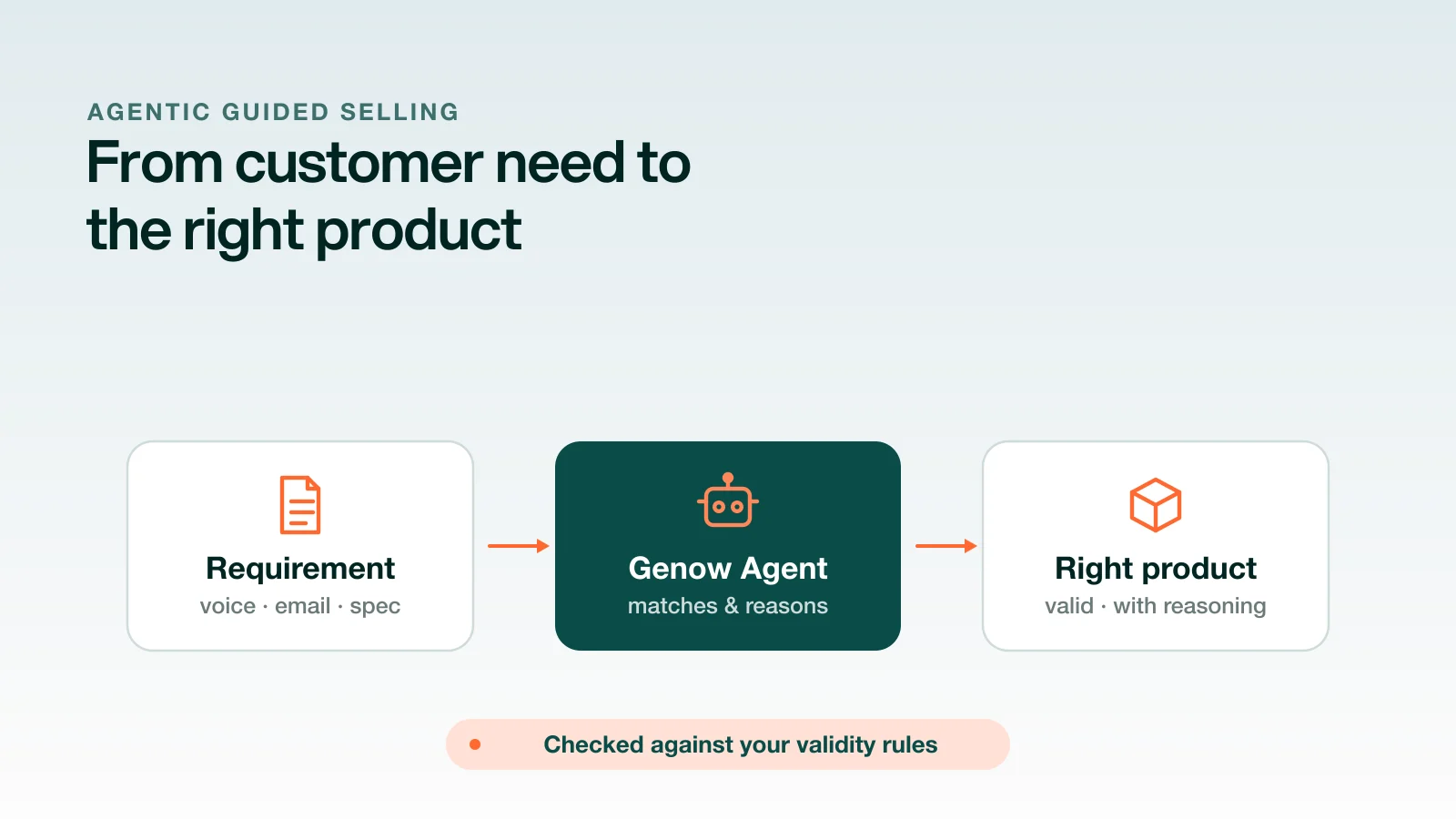
Agentic guided selling is an AI-driven sales approach in which an agent interprets a customer requirement in any form – a conversation, an email, or a formal spec/RFP – then finds the right, buildable product or variant, explains the choice, and assembles the sales materials. Unlike classic guided selling (question-tree wizards) and unlike CPQ (which configures only once the requirement is already structured), it starts at the unstructured front of the deal: at requirement-to-product matching.
What agentic guided selling means
Most people know classic “guided selling” as a question tree: the customer clicks through predefined options until one product remains. That works for small catalogs – and breaks down exactly where makers of tailored goods earn their money: across tens of thousands of variants, options, and validity rules that no single person can hold in their head.
Agentic guided selling inverts the principle. Instead of leading the human through a decision tree, an agent does the actual thinking: it understands what the customer wants to achieve, matches that against the real portfolio, and proposes the right product – including why it fits and why other options are excluded. The rep delegates the step; the agent delivers the result.
The decisive difference is in the word “agentic.” This is not a chatbot that searches documents, but an acting agent that researches, matches, writes, and assembles materials – inside a deal workspace where every lead is its own project.
The problem agentic guided selling solves
In a complex portfolio, the right product for a given customer is usually not the one the rep happens to know best. The result: under-selling, mis-matching, or a stalled deal that escalates to a scarce expert. Estimates in complex sales put it at roughly one application/sales engineer per ten reps – a structural bottleneck.
At the same time, reps have little time to actually sell: studies show reps spend only around 28–30% of their time selling; the rest goes to research, searching for and creating content, and quote prep. 84% of sales leaders name content search and utilization as their single biggest productivity gap. This is precisely where agentic guided selling intervenes.
The inputs are almost never finished part lists but requirements: “stainless steel, ATEX Zone 1, 400 bar,” a 50-page spec, or an offhand remark in a meeting. Even formal specifications are often incomplete or written in the customer’s language. The real value work is translating that requirement into the right configurable product.
How requirement-to-product matching works
At the core of agentic guided selling sits requirement-to-product matching: the agent is connected to the company’s product knowledge (datasheets, sales arguments, presentations – often on SharePoint), to the custom options/variants database with its validity rules, to price lists, and to research across public competitive sources.
-
Capture the requirement: spoken, by email, or as a spec/RFP – the agent structures it and asks about gaps.
-
Check against the options database: only valid, buildable combinations qualify – no generic guessing.
-
Propose with reasoning: the agent ranks fitting products and explains “fits because …” and “excluded because …”.
-
Escalate hard cases: an expert takes over with full context – instead of starting a new email thread.
-
Generate materials: the right arguments, correct prices, a personalized presentation – from the same workspace.
Because every recommendation is checked against the validity rules and backed by sources, the risk of a “confident-but-wrong” suggestion drops sharply. Where certainty isn’t possible, the agent says so and routes to engineering.
Agentic guided selling vs. neighboring categories
| Approach | Starts at | Limit |
|---|---|---|
| Classic guided selling | Question tree with fixed options | Doesn’t scale across thousands of variants; B2C-weighted |
| CPQ / configurator | An already-structured requirement | Configures only once it’s clear WHAT to build |
| Generic AI chat | Document Q&A | Guesses at the product; no validity rules |
| RFQ automation | A resolved part list (distributor) | Fulfills orders; doesn’t interpret requirements |
| Agentic guided selling (Genow) | The unstructured requirement at deal start | Sits before the configurator – and can feed it |
Importantly, agentic guided selling replaces none of these categories – it occupies the gap before them. Genow sits before CPQ and delivers the valid starting point-
Proof from practice
In live deployments with manufacturers of complex products, the agent is connected to product knowledge (often on SharePoint), an options database with tens of thousands of valid options and validity rules, price lists, and research from public competitive sources. Reps talk to the agent, capture requirements, find valid options, and sharpen their arguments. This shows the hard part – matching against a real, rule-based options database – works in practice.
Why “agentic” instead of “another tool”
Sales software notoriously dies on adoption: CRM rollouts fail 50–63% because tools feel like admin work. Only about 26% of reps use the battlecards their marketing makes. Agentic guided selling breaks the pattern because the rep delegates instead of maintaining – the agent does the work, and the workspace is where finished deliverables accumulate, not where the rep labors. Voice as the entry point reinforces this: speaking is roughly three times faster than typing.
And the lane is open: 33% of field-sales teams use no AI at all; fewer than 20% use it for the higher-value tasks. Establishing agentic guided selling now means being early, not late.
FAQ
What is agentic guided selling?
An AI-driven sales approach in which an agent interprets a customer requirement in any form, finds the right buildable product, explains the choice, and assembles the sales materials – all inside a deal workspace.
How is it different from CPQ?
CPQ configures and prices after the requirement is structured. Agentic guided selling sits before that: it translates the unstructured requirement into the valid starting point – and can then feed the CPQ.
Is this just a chatbot for documents?
No. A generic chat searches documents and guesses at the product. Agentic guided selling checks against the options/variants database with validity rules and is designed to propose valid, buildable products – with reasoning and sources.
Does the agent replace the rep?
No. The approach augments consultative selling: the human keeps control and the relationship; the agent handles research, matching, and materials.