How to Write a Winning RFP Response (Template Included)
Fewer questions for engineering, on-time submissions, a higher hit rate: structure, template and wording for RFP responses that actually convince.
Key takeaways
An RFP response rarely wins on more words — it wins on precise, technically correct answers that map directly to the spec.
- The average RFP win rate is 45%, but the effort is real: manufacturers invest 12–28 hours per proposal.
- For many industrial companies, RFPs aren’t a side channel — up to 40% of revenue comes through RFP processes.
- 68% of teams now use generative AI to help with RFP responses, up from 34% in 2023.
- Relationship-based pursuits win 60–90% of the time versus around 15% for cold bids — speed and precision of the response are the lever sales teams can actually control.
Table of contents
- What makes an RFP response successful?
- Structure of a winning RFP response
- Template: RFP response skeleton to copy
- RFP response vs. a standard quote
- Classic RFP process vs. AI-assisted process compared
- RFP responses in practice: from spec sheet to draft proposal
- Why RFP responses need agentic support now
- FAQ
What makes an RFP response successful?
An RFP (Request for Proposal) is a structured tender in which a prospective customer lays out detailed requirements for product, technical spec, delivery terms, and price. Unlike a standard quote, this isn’t won on creativity but on precision: every requirement in the spec document needs a concrete, traceable answer. Vague or incomplete answers lead almost automatically to disqualification, regardless of how well the product actually fits.
Structure of a winning RFP response
A solid RFP response typically follows this structure:
- Executive summary — short, concrete statement of why the solution fits.
- Point-by-point answers to requirements — each requirement from the spec referenced individually, not answered in general terms.
- Technical specification and evidence — concrete data instead of marketing language.
- References and proof — comparable projects, ideally with numbers.
- Pricing and delivery terms — clearly structured, no hidden caveats.
Template: RFP response skeleton to copy
Ready to fill in and adapt:
1. EXECUTIVE SUMMARY
[2–3 sentences: why does our solution fit this specific need?]
[One number or reference that backs the claim]

2. REQUIREMENTS MATRIX (one row per spec item)
Requirement #[X]: [exact wording from the spec document]
→ Met: [Yes / Partially / With modification]
→ Answer: [concrete technical answer, no marketing language]
→ Evidence: [spec sheet, certification, reference project]

3. TECHNICAL SPECIFICATION
[Relevant specs, standards, certifications as a table or list]

4. REFERENCES
[Comparable project 1: industry, scope, result in numbers]
[Comparable project 2: industry, scope, result in numbers]

5. PRICING AND DELIVERY TERMS
[Pricing model, payment terms, delivery time, quote validity]

6. NEXT STEPS
[Concrete proposal: meeting date, point of contact, deadline]
This skeleton mirrors the structure from the section above and gets filled in per tender with the specific requirements — the requirements matrix (item 2) is typically the part that eats up most of the response time on any given RFP.
RFP response vs. a standard quote
A standard quote answers a direct request in a known format. An RFP response, by contrast, has to reference an often multi-page, formally structured spec document point by point — including technical requirements that frequently trigger questions back to product development or engineering. That makes RFP responses considerably more work, and more vulnerable to delay when the needed technical knowledge isn’t readily available inside the sales team.
Classic RFP process vs. AI-assisted process compared
| Criterion | Classic RFP process | With AI-assisted preparation |
|---|---|---|
| Time per proposal | 12–28 hours | significantly reduced by reusing vetted answers |
| Questions back to engineering | frequent, delays the response | rarer, since product knowledge is directly accessible |
| Consistency of answers | varies by whoever drafts it | uniform via a central knowledge base |
| Reuse of past proposals | often not systematic | past answers usable as a foundation |
| Speed under tight deadlines | bottlenecked by capacity | scales independent of staff availability |
RFP responses in practice: from spec sheet to draft proposal
In practice, the biggest time sink is rarely the writing itself — it’s tracking down the right technical answers across spec sheets, old proposals, and the knowledge held by individual engineers. A team receiving a 40-page spec document spends most of its time checking requirements one by one and finding the right answer somewhere in the company, not actually drafting the response.
Why RFP responses need agentic support now
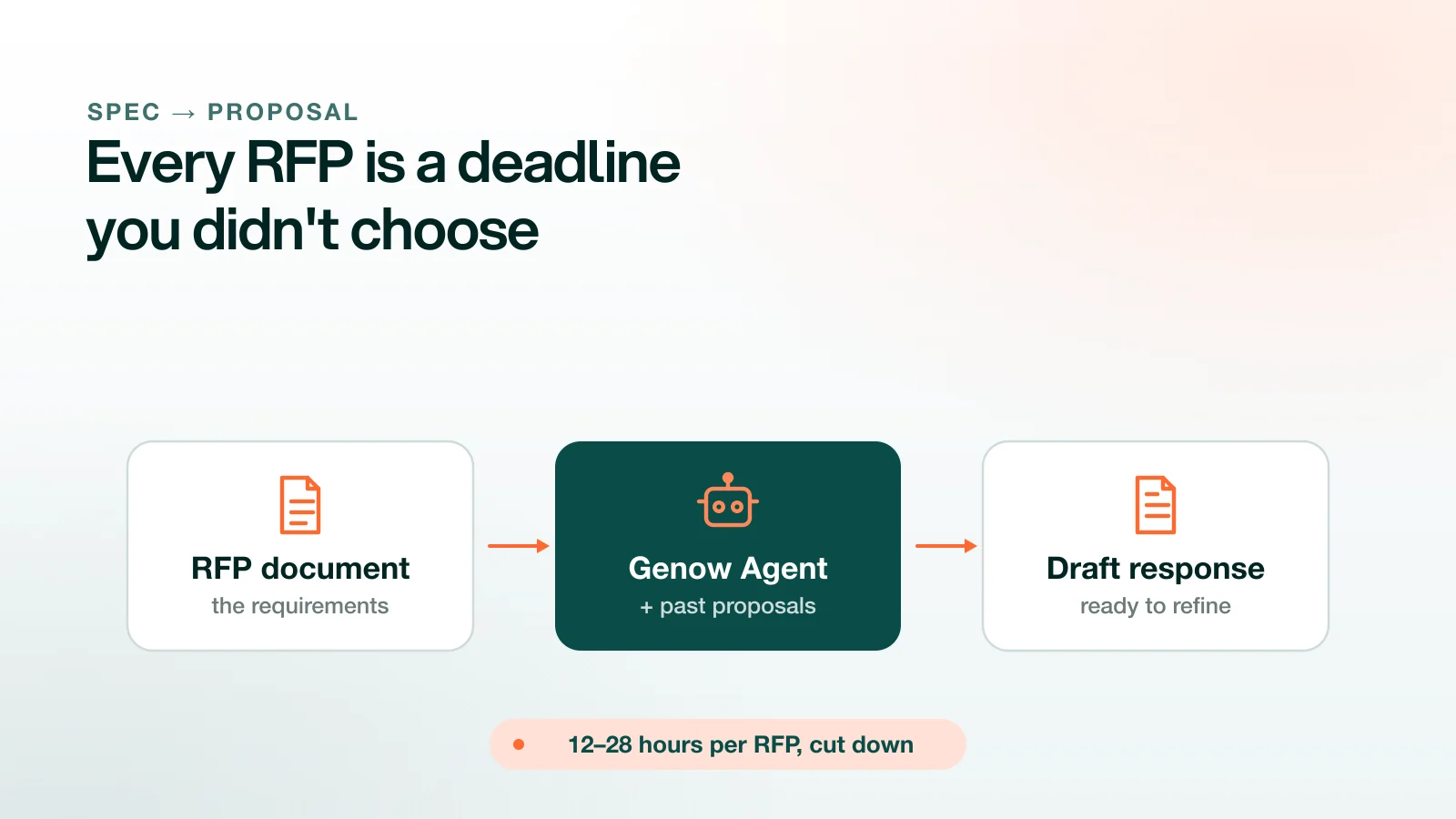
AI tools such as Genow apply this exact approach: they ingest an incoming spec document in a structured way, match every requirement against existing product and proposal documentation, and produce a first, technically grounded draft response — which sales and engineering then review and approve. That shifts where the time goes: less searching, more reviewing and refining by sales and engineering.
FAQ
What's the difference between an RFP and an RFQ?
An RFP (Request for Proposal) asks for a solution including technical approach and price; an RFQ (Request for Quote) usually just asks for a price against an already defined spec.
How long does a typical industrial RFP response take?
Depending on complexity, between 12 and 28 hours of actual work, often split across sales, engineering, and management.
What are the most common reasons RFP responses lose?
Vague or incomplete answers to concrete requirements, late submission, and missing technical evidence are the most common reasons.
Can AI write a complete RFP response on its own?
Genow's AI agents can produce a structured first draft based on existing product data, which sales and engineering then review and refine — saving mostly on research time.
Is the effort worth it for smaller tenders?
That depends on deal size and the strategic importance of the customer — for recurring tender formats, building a reusable knowledge base pays off especially fast.
How important is speed in RFP responses?
Very: relationship-based, well-prepared responses win far more often than late or generic responses to cold tenders.