The Context AI Agents in Industrial Sales Actually Need
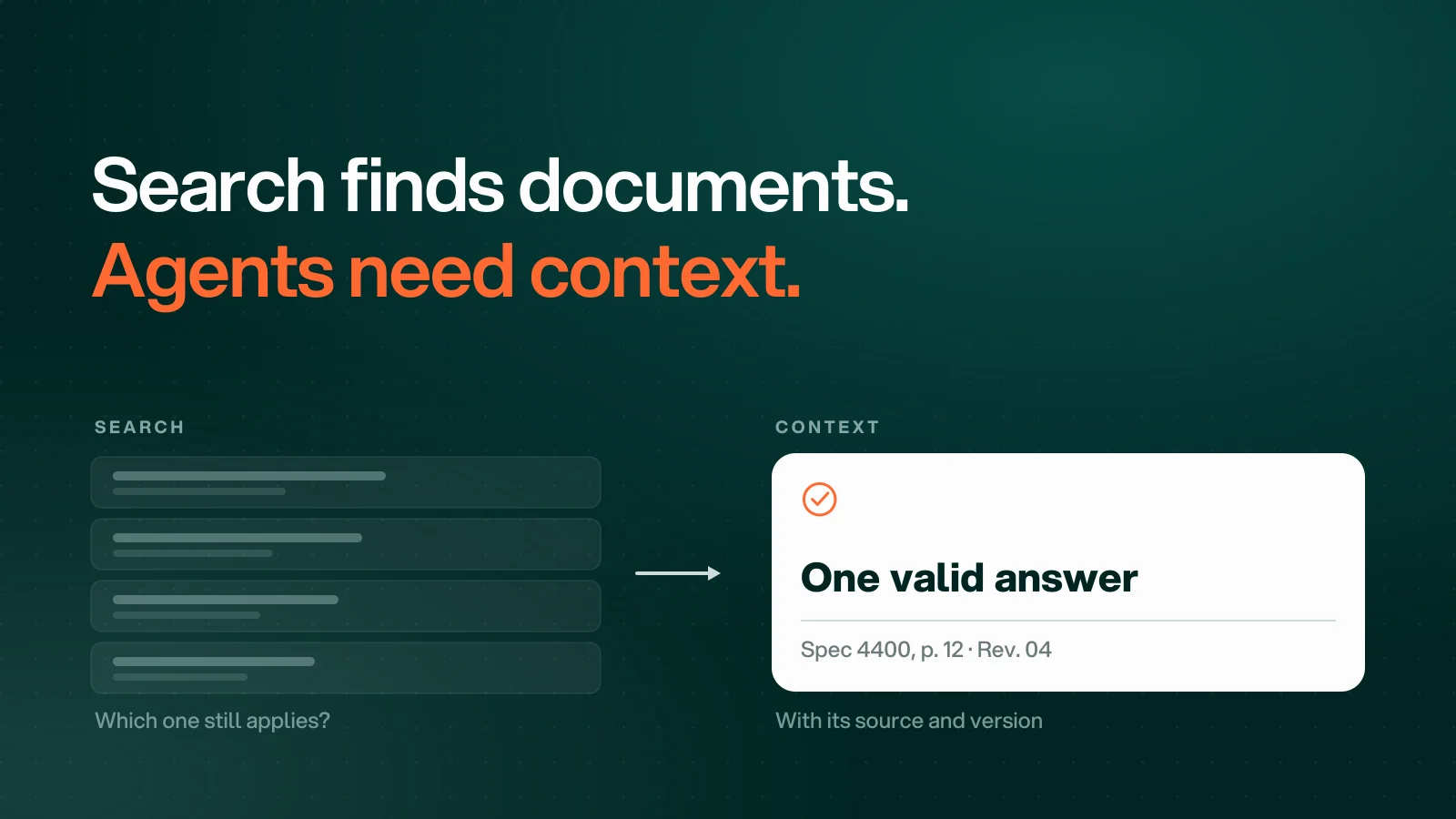
Search finds documents, AI agents need context. Why connecting your systems is not enough, and which layer sits beneath them.
Key takeaways
The past two years solved access. Connectors, open protocols and assistants now reach almost every system in the enterprise. Reliable answers did not follow, because an agent needs more than access. It needs context.
- Search was built for humans. A person discards the wrong hit in two seconds; an agent builds three more work steps on top of it.
- A connector delivers files, not understanding. Your vocabulary, your rules, the relationships between systems and the permissions are in none of them.
- In industrial sales the valid answer matters, not the likely one. Speculating about a seal, a sign-off or a margin corridor creates cost instead of removing it.
- An agent’s most valuable answer is sometimes “this is not documented anywhere”. Logged knowledge gaps are the shortest path to better documentation.
- Reps sell only around 28-30% of their time. The rest goes into searching and assembling, which is exactly the work a context layer takes over.
Table of contents
- Search was built for humans
- Access is not understanding
- What an agent in industrial sales actually needs
- Why “we already have search” is not the answer
- Search and context compared
- From practice: the gap as a deliverable
- The layer beneath the agents
- FAQ
Search was built for humans
Enterprise search solved a real problem: finding documents again. But it solved it for one particular user, a human with prior knowledge. A sales engineer gets ten results, recognises within two seconds that result three is from 2019 and result seven belongs to the wrong product series, and carries on with the rest. The result list was allowed to be fuzzy, because the human silently corrected the fuzziness.
An agent has none of that prior knowledge. It takes the first plausible hit, derives a configuration from it, checks that against a price range and turns the outcome into a paragraph of the proposal. The wrong 2019 result is no longer an annoyance; it is the foundation of three further work steps. Errors compound quietly, and what comes out at the end is a document that looks professional and does not hold up technically.
That is the real break. The models are not the bottleneck. The assumption is: that a retrieval quality good enough for people is also good enough for machines.
Access is not understanding
The reflex response to this problem is to connect more. And access genuinely is largely solved by now. Standard connectors, open protocols and integrations into SAP, Salesforce, HubSpot, SharePoint, Confluence or Teamcenter are engineering, not research. But none of those connections answers the questions an agent in industrial sales actually fails on. Four things sit in no connector:
- Language. Your company calls a component “Series 4”, the supplier calls it something else, and the service report just writes down an order number. Without your glossary those are three different things.
- Logic. Which module is compatible with which, which option triggers a certification, which margin corridor is permissible: that rarely sits in a document. It follows from rules.
- Relationships. A proposal, a ticket, a drawing and an account belong together. Four systems have no idea about each other.
- Permissions. A costing a sales director may see is not one an external partner may see. An agent that checks permissions in the interface has already breached them.
Those four levels are precisely the job of the Genow Context Engine. It does not just ingest the connected sources. It resolves terminology, adds your rules, links records across system boundaries and inherits permissions all the way down into the individual retrieval.
What an agent in industrial sales actually needs
Looking from the connector towards the deliverable makes the requirement list concrete. An agent a sales or service team genuinely trusts needs:
- The valid answer, not the likely one. A language model is trained to produce a plausible formulation. But a sign-off, a tolerance or a price is not plausible. It is right or wrong.
- Sources down to the line and the version. Not “according to the documentation”, but the line, the document and the revision state, plus one click into the original. Verifiability is not a bonus feature. It is the precondition for anyone putting their name on the result.
- Superseded means superseded. When a new revision arrives, the old figures go out of service with it. Otherwise someone eventually quotes last year’s price list and nobody notices.
- Permissions at retrieval. Who may see what has to be decided when the content is retrieved, not when it is displayed. Whatever holds in your security and compliance architecture has to hold for every intermediate step an agent takes.
- An honest “this is not documented anywhere”. When context is missing, saying so is worth more than filling the gap.
- Context across multiple work steps. A proposal does not come out of one question but out of a chain: read the requirement, check the history, derive modules, verify the price range, write the text. Each step needs the right slice, not everything.
Why “we already have search” is not the answer
Context does not replace search. It sits underneath it. Good search remains the precondition, and agents actually make it more important, because its results now get processed further instead of merely displayed. The difference lies in what happens after the search.
The same applies to the obvious market comparison. A generic assistant, or an agent built with Copilot Studio, delivers out-of-the-box quality across its own system world: good phrasing, acceptable result lists, fast first outcomes. What it does not bring is the configuration logic of your portfolio, your vocabulary, your margin rules, and the option to give the same knowledge access to your own end customers. So the right question in an evaluation is not “which systems can the tool connect to”. It is: what happens to the connected data before an agent uses it?
Search and context compared
| Criterion | Search and connectivity | Context layer beneath the agents |
|---|---|---|
| Output | a result list to choose from | exactly the slice the work step needs |
| Terminology | full text and similarity | resolved via your glossary and product hierarchy |
| Rules | not included | compatibilities, sign-offs, margin corridors encoded |
| Relationships | separate per system | proposal, ticket, drawing and account linked |
| Traceability | a link to the document | document, line and revision state |
| Permissions | checked when someone opens a result | checked on every retrieval, including intermediate steps |
| Outdated versions | stay findable | taken out of service with the new revision |
| Missing context | empty result list | a declared gap plus a log entry |
From practice: the gap as a deliverable
The effect that surprises sales and service teams most in real projects is not the speed. It is the gap list.
When an agent logs every question it cannot substantiate from the existing knowledge, a sorted list of the places where your own documentation does not hold appears within a few weeks. At industrial customers that list typically fills up with compatibility rules only three senior colleagues know, sign-off states that never made it out of an email into a system, and product series whose pricing logic exists only in a spreadsheet. This is not a deficiency report. It is a prioritised task list, and it is the fastest route from a good agent to a dependable one.
The second effect from practice is reuse. For a typical proposal, 70-80% of the answers already sit in earlier proposals. Without a context layer they stay out of reach, because nobody knows which of the 400 past proposals is the right one. With it, research and proposal work run through as a single flow, with nobody switching between tools in between, and what comes out is a draft reps only have to refine.
The layer beneath the agents
In practice users do not have to decide which agent performs which task, from the Briefing Agent to the CRM Agent: the system decides that. So that the answer never depends on which agent picked up a request, every agent draws on the same context. That is what makes an AI Workspace: several specialised agents working on one shared knowledge base. For a single bounded topic, there is a Genow Project.
Working agentically does not mean simply running more AI models. What matters is the shared foundation: it knows what terms mean inside your company, which rules apply, which information is still current and who is allowed to access it.
FAQ
What is the difference between enterprise search and context?
Search returns a result list a human chooses from. A context layer returns a resolved, permission-checked and versioned slice an agent with no prior knowledge can work with. Search remains the precondition; context is the layer on top of it.
Isn't connecting our systems to an AI tool via APIs enough?
Connectivity solves access, not understanding. Without your vocabulary, your configuration and sign-off rules, the links between systems and permissions applied at retrieval, the agent gets files but no dependable basis for an answer.
How do we know an agent is not hallucinating?
Two ways: every statement points to a document, a line and a revision state, and missing context produces a declared gap instead of a filled one. An agent that never says "this is not documented anywhere" is not a better agent, just a less honest one.
How is this different from an agent built with Copilot Studio?
Copilot Studio delivers solid generic quality inside the Microsoft world. A specialised agent on a context layer additionally knows the configuration logic of your portfolio, your margin rules and your terminology, connects to arbitrary third-party systems, and can expose the same knowledge access to your end customers.
Do we have to clean up our documentation before we start?
No, and that is the point. The agent shows you which gaps actually hurt, because it logs every question it cannot answer. That list is far shorter and far better prioritised than a documentation project done on spec.
Are permissions from SAP and SharePoint preserved?
Yes. Permissions are inherited per document and checked at retrieval, not at display time. Genow runs EU-hosted or inside your own cloud for this, with no model training on your data.