Before the Configurator: Why CPQ Alone Doesn't Solve the Inquiry (Genow vs. Tacton & Configit)
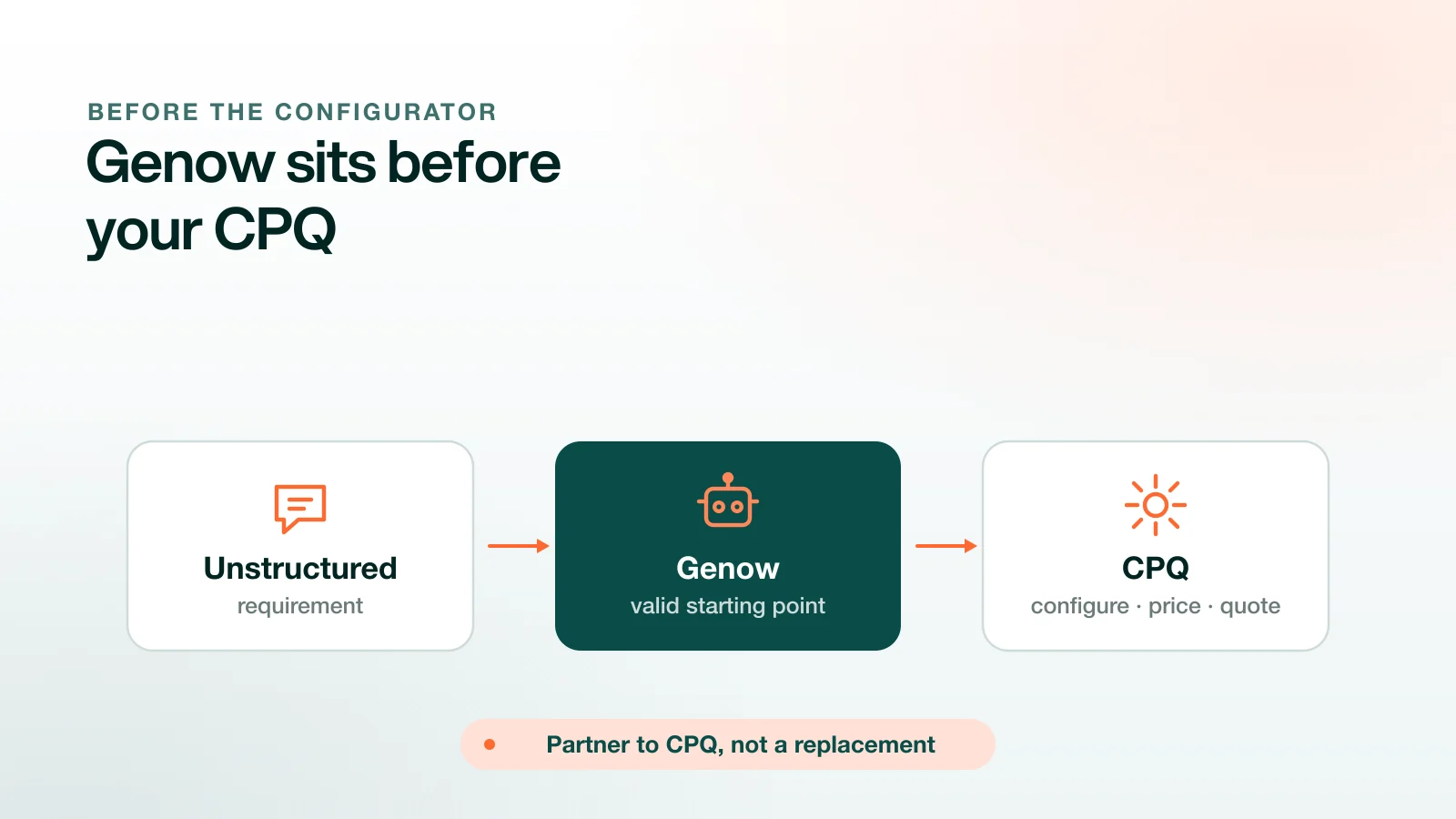
CPQ configures only once the requirement is structured. Genow is not a CPQ: it sits before it, delivers a valid starting point and feeds the CPQ.
Key takeaways
CPQ systems like Tacton or Configit configure and price a product once the requirement is structured. Genow is not a CPQ and does not replace one. Genow works in front of it and makes the CPQ more effective.
- CPQ assumes it is clear what should be built. In technical sales, though, the requirement arrives as a conversation, an email or a specification and has to be interpreted first.
- Genow translates that unstructured inquiry into a valid starting point: the right product, checked against validity rules and justified.
- That starting point flows into the existing CPQ, which takes over detailed configuration and pricing. Both systems work together.
- If you are looking for a Tacton alternative because quotes still take too long despite a configurator, the bottleneck usually sits in front of the configurator, not inside it.
Table of contents
- What CPQ does and where it starts
- What Genow solves before that
- CPQ and Genow head to head
- Three scenarios and the verdict for each
- What if the CPQ gets its own AI?
- FAQ
What CPQ does and where it starts
CPQ stands for Configure, Price, Quote. These systems excel at deterministically turning an already structured requirement into a buildable, correctly priced configuration. Vendors such as Tacton, Configit and encoway own the back half of the quoting process, and rightly so. How both halves work together is covered in the guide to CPQ with AI.
The blind spot is the beginning: CPQ assumes it is already clear what should be built. In consultative selling of complex products, that is rarely the case. The requirement arrives as a need, an incomplete specification or a sentence in a conversation. “We need to tap M8 blind holes in stainless steel” is not a part number but a need that someone has to translate first.
What Genow solves before that
Genow matches the requirement to the product before the CPQ comes into play:
- Structure the requirement. A conversation, email or specification becomes an ordered list with values, units and standards. Where something is missing, the result is a targeted question.
- Check against the portfolio. The requirements are matched against data sheets, option data and validity rules, across every product series.
- Justify the starting point. The result is the right product family and a valid starting point, with reasoning and a source.
- Hand over to CPQ or SAP. The starting point flows into the CPQ or straight into SAP, which takes over detailed configuration and pricing from there.
If you already run Tacton or Configit, you replace nothing; you close the gap at the start of the sales process. What this looks like in Genow is shown on the page on AI-assisted product configuration.
CPQ and Genow head to head
| Dimension | CPQ (Tacton, Configit, encoway) | Genow |
|---|---|---|
| Starts at | An already structured requirement | An unstructured requirement (conversation, email, specification) |
| Core job | Configure, price, quote | Interpret the requirement, find the right product, create sales arguments and materials |
| Input | Structured options | Natural language, documents |
| Strength | Deterministic, buildable configuration | Justified matching of need to product |
| Relationship | Back half of the process | Sits before it and feeds the CPQ |
| Users | Configurator-trained roles | Field and inside sales, including by voice |
Three scenarios and the verdict for each
Scenario 1: you have no CPQ yet. Genow delivers the right product and the proposal draft straight from the requirement. Verdict: Genow creates fast value on the documents you already have. A CPQ can be added later for detailed configuration.
Scenario 2: you already run Tacton or Configit. Detailed configuration is solid, but reps struggle to reach the right starting point. Verdict: put Genow in front of it. It feeds the valid starting point into the CPQ, and both systems work together.
Scenario 3: you are looking for a Tacton alternative because quotes still take too long despite a configurator. Verdict: first check where the time is lost. If it is in the rule set itself, comparing configurators makes sense. If it is earlier, in understanding the request and in questions to scarce application engineers, a different configurator changes nothing. Then Genow relieves the bottleneck, and the existing CPQ keeps building the final configuration.
What if the CPQ gets its own AI?
CPQ vendors are adding generative AI of their own, for example Tacton with an AI assistant for product modelling. The difference remains structural: an explainable interpretation of the unstructured inquiry, checked against validity rules and combined with customer research, competitive arguments and personalised materials, is not the core field of a configuration and pricing engine. That is exactly where Genow complements the CPQ.
FAQ
Is Genow a CPQ replacement?
No. Genow is not a CPQ system. It sits before the CPQ and translates the unstructured requirement into a valid starting point. The CPQ takes over detailed configuration and pricing from there.
Is Genow a Tacton alternative?
Not in the sense of a replacement. Anyone looking for a different configuration system is comparing rule sets. Genow solves a different problem: the path from customer request to the right product, before the configurator comes into play.
What is the Tacton configurator?
Tacton is CPQ and configuration software for manufacturers with complex, variant-rich products. It checks configurations against a technical rule set and produces priced quotes from them.
Can Genow feed an existing Tacton or Configit?
Yes. The validated starting point from matching can flow into the CPQ so both systems work together.
Do I need Genow if I already have a CPQ?
If reps struggle to reach the right starting point or inquiries keep escalating to experts, Genow closes exactly that gap at the start of the sales process.