Automating Quotes in Machine Building: From Spec to Proposal Draft in Hours
Automating quotes in machine building: how AI turns a spec or tender into a sourced proposal draft in hours, and what stays with your sales team.
Key takeaways
In machine building, a quote is a technical solution with a price. What can be automated is mainly the work that comes before the pricing decision, and that is exactly what costs the most time today.
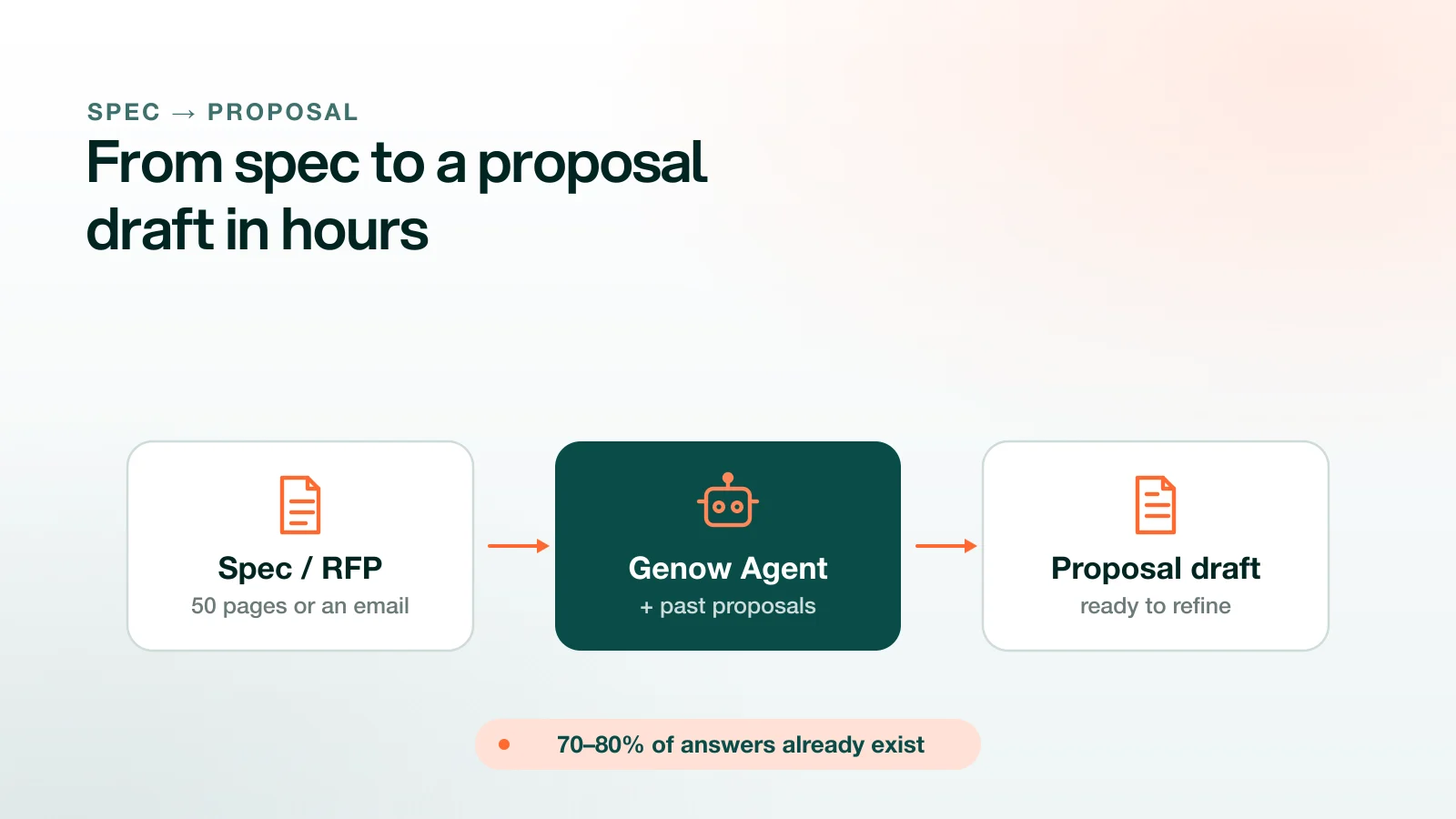
- 70 to 80 % of the answers to a specification already sit in earlier proposals. Sales and application engineering still often spend days pulling them together.
- AI reads the spec, tender or email, proposes a buildable product and turns it into a complete draft proposal in the company template, with a source for every statement.
- Special requests are checked before they reach design engineering: does a standard product fit, has it been built before, or is it genuinely new?
- Pricing decisions, terms and the customer relationship stay with sales. The AI prepares; people decide and approve.
- An existing CPQ is not replaced but filled with a valid starting point.
Table of contents
- Why quotes in machine building take so much time
- Which steps of quoting can be automated
- Special requests: check first, then design
- What stays with people
- Quoting today vs. with AI
- For bid and proposal management too
- Not distributor-style RFQ automation
- From practice
- FAQ
Why quotes in machine building take so much time
A quote for a machine or plant is not a catalogue extract. It describes a technical solution to a specific need, and that solution has to be buildable, verifiable and correctly priced. How quoting, configuration and CPQ connect into one flow is explained in the guide to CPQ with AI.
Whether it is a tender or a 50-page specification, most of the answers already exist, scattered across old proposals, data sheets and specifications. The effort arises in three places:
- The request is incomplete. Customers describe their need, not their configuration. Values are missing, standards are not named, constraints sit between the lines.
- The knowledge is scattered. Data sheets, option lists, price lists and earlier proposals live in different systems, often in different versions.
- The experience is scarce. Only a few people in application and project engineering know which configuration has worked in similar cases. Every question to them lengthens the turnaround.
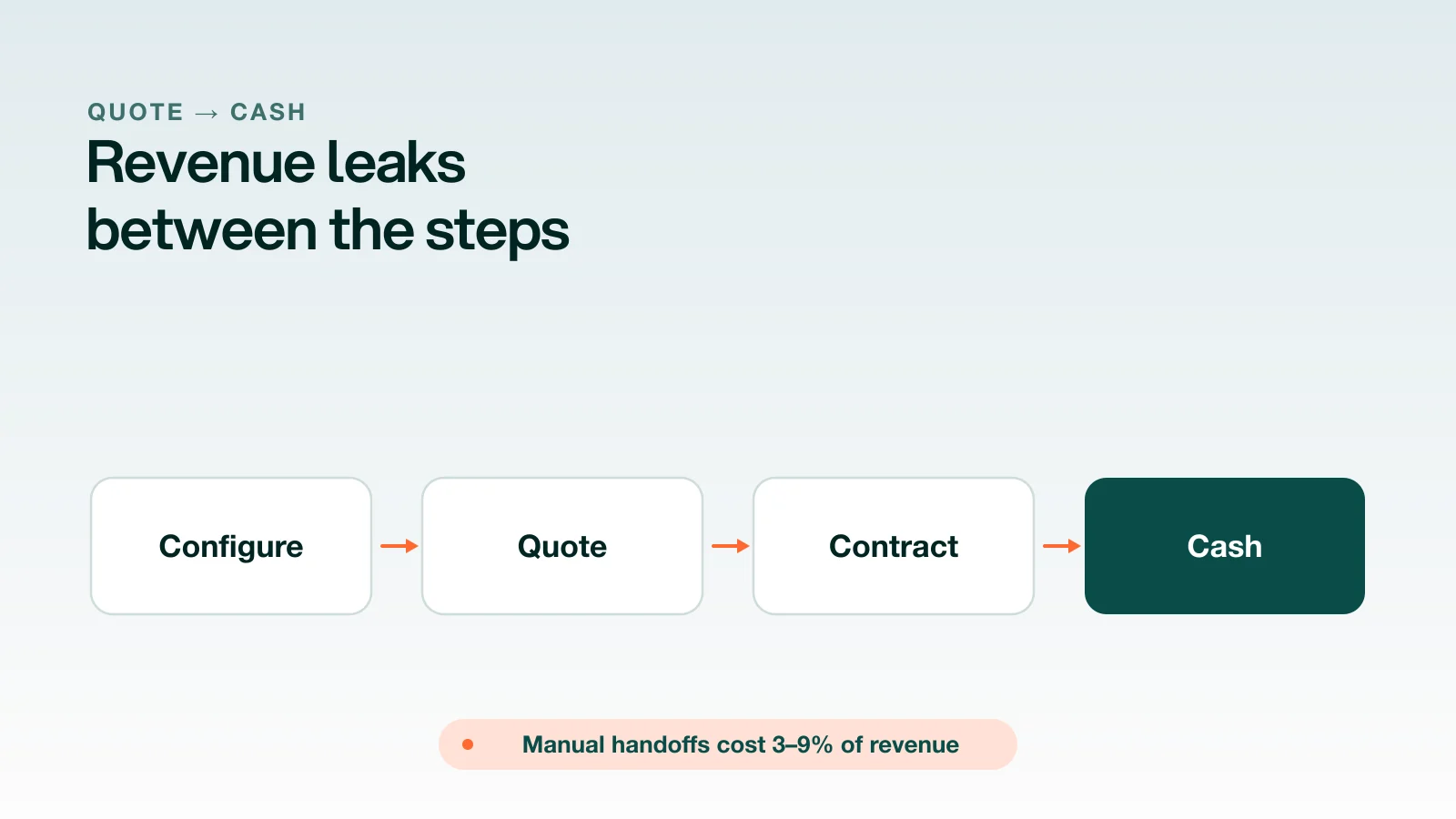
This is no edge case. Reps already sell only around 28–30 % of their time, and roughly 31 % (about twelve hours a week) goes to finding and creating content alone. By the time your proposal is ready, a competitor has often already delivered.
Which steps of quoting can be automated
Writing a proposal with AI does not mean having a text generated. It means automating the preparatory steps that cost the most time today:
- Evaluate the request. The spec, tender, email or call notes are read and the requirements structured, even with customer-specific abbreviations and terminology. Missing information is turned into a question.
- Propose product and configuration. The requirements are checked against data sheets, option data and validity rules. The result is a buildable proposal with a justification.
- Reuse proven content. Descriptions, technical explanations, arguments and references are taken from won proposals for similar cases and adapted.
- Create the draft proposal. Everything flows into a draft in the company template, with prices from the price lists. Every technical statement points to its source.
- Check against specification and contract. Before approval, the draft is laid against the specification, contract terms and factory standards. The experts review a handful of findings instead of hundreds of pages: a penalty clause that is not priced, a factory standard that is not met, an acceptance test missing from the scope, a price below similar projects.
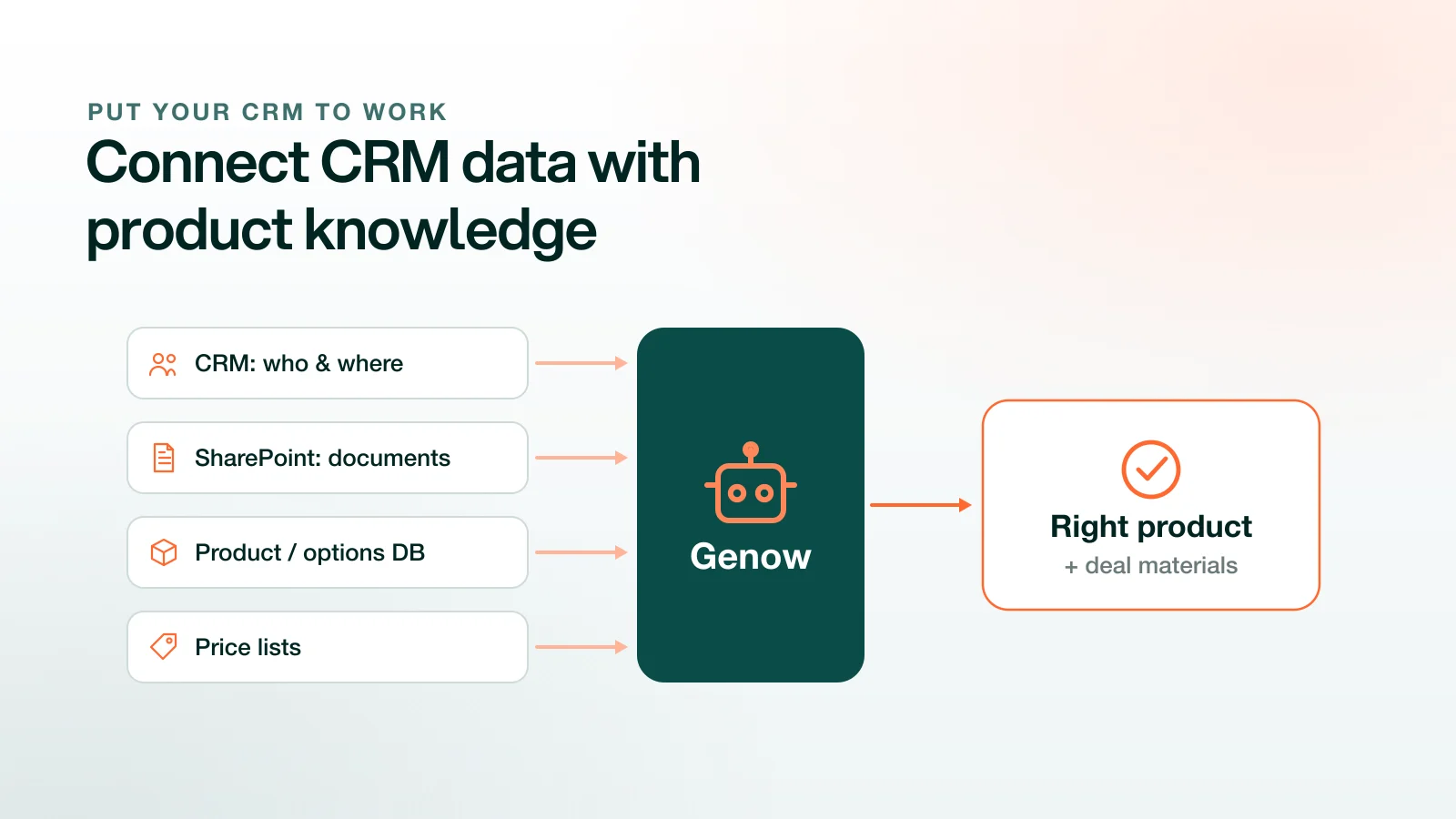
Because the right product is found first and the proposal is built second, the draft is not only fast but technically sound. In Genow, this happens in one chat: the workspace decides which specialist takes the request, and nobody has to switch between tools. Read more about AI-assisted proposal writing on its own page.
Special requests: check first, then design
In machine building, few things cost as much time as the special request. It lands in design engineering, which starts from scratch, and weeks pass before the quote. Yet something very similar has often been built already, just for another customer and in an archive nobody searches.
An example: the request is for a stainless steel housing to IP67, flange DN 80, PN 16, for temperatures up to 180 °C. A few years ago almost the same thing was built for another customer, rated up to 200 °C even. The drawing, bill of materials and price exist; nobody finds them.
So every special request is checked before it reaches design engineering. There are three possible outcomes:
- A standard product fits. The quote comes straight from the catalogue or the modular system.
- It has been built before. Drawing, bill of materials, price and lessons from the earlier order are at hand and get adapted.
- It is genuinely new. Then the request goes to design engineering, with a complete brief instead of a forwarded email.
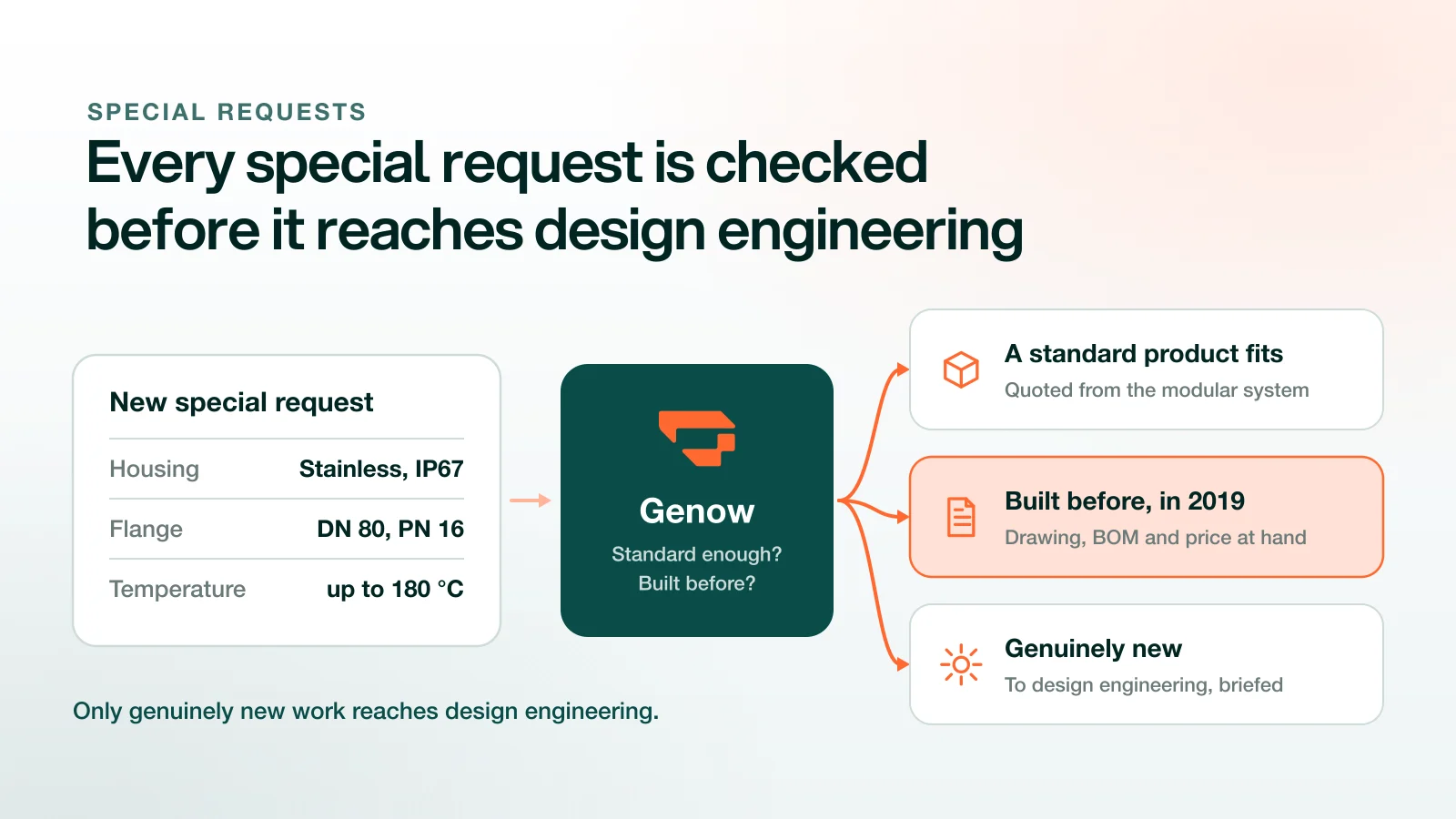
That way, only genuinely new work reaches design engineering.
What stays with people
Automated quoting does not replace sales. It shifts the work from searching to deciding.
- Price and terms. Pre-calculation, discounts, payment terms and strategic prices are decisions, not research. They stay with sales or run through the rules in the CPQ.
- The customer relationship. Which solution this customer needs right now, what was said in the last conversation and what matters to them is what people bring.
- Approval. A quote is binding. The AI delivers a draft; sales reviews and approves.
Quoting today vs. with AI
| Step | Today | With AI |
|---|---|---|
| Capturing the spec | Read by hand | Automatically structured, gaps turned into questions |
| Finding answers | Days searching old proposals | Matched from proposal history and product knowledge |
| Choosing the product | From memory, often the familiar one | Buildable, justified, checked against rules |
| Special request | Straight to design engineering, from scratch | Checked first: standard, built before or genuinely new |
| Draft proposal | Start from zero in the template | Complete in the company template, with sources |
| Review | Spot check before sending | Every requirement and every contract clause matched |
| Role of sales | Searching and assembling | Reviewing, deciding, approving |
For bid and proposal management too
The same principle helps the teams who write proposals and tender responses full time. Connected to the history of earlier proposals, the draft is built together with the author and refined step by step, instead of starting from a blank page every time. What won before gets reused. How long tenders are answered in detail is covered in How to write an RFP response.
Not distributor-style RFQ automation
The distinction matters: this is not the RFQ automation distributors use. Those tools read resolved part lists and price them into the ERP. Manufacturers of configurable products first have to determine the right product from their own portfolio. The difference lies in the job, not in the document format.
From practice
The KION Group, home to brands such as Linde and STILL, uses Genow with more than 2,000 active users worldwide. Configuration and quote preparation run twice as fast as before. The reason: answers to technical questions are ready in seconds, each with the source it came from. Read the full story in the KION case study.
FAQ
Can a proposal be written entirely with AI?
The draft, yes; the decision, no. The AI creates a complete draft proposal from the request, product knowledge and earlier proposals. Price, terms and approval stay with sales.
What is an AI draft proposal?
A complete proposal in the company template that addresses every customer requirement and names the source for every technical statement. Sales revises it instead of starting from zero.
How fast is a draft produced from a specification?
In hours rather than days, because 70 to 80 % of the answers already sit in earlier proposals and are matched automatically. That also applies to formal, multi-page specifications.
What happens to special requests?
They are checked before they reach design engineering: does a standard product from the catalogue or modular system fit, has something similar been built before, or is the request genuinely new? Only in the last case does it go to design engineering, then with a complete brief.
Do we need a CPQ system for this?
No. The AI works directly on data sheets, option data, price lists and past proposals. If a CPQ is in place, it is filled with a valid starting point.
How do you prevent wrong technical details in a proposal?
By requiring sources. Every statement in the draft points to a document inside the company. Whatever cannot be sourced is marked as open, not invented.
Is this RFQ automation like distributors use?
No. Distributor tools price resolved part lists. Here the requirement is interpreted and the right, buildable product is determined from your own portfolio.