Quote-to-Cash Explained: From Configuration to Closed Deal
What is quote-to-cash? How the process from quote to payment works, and where industrial companies lose revenue.
Key takeaways
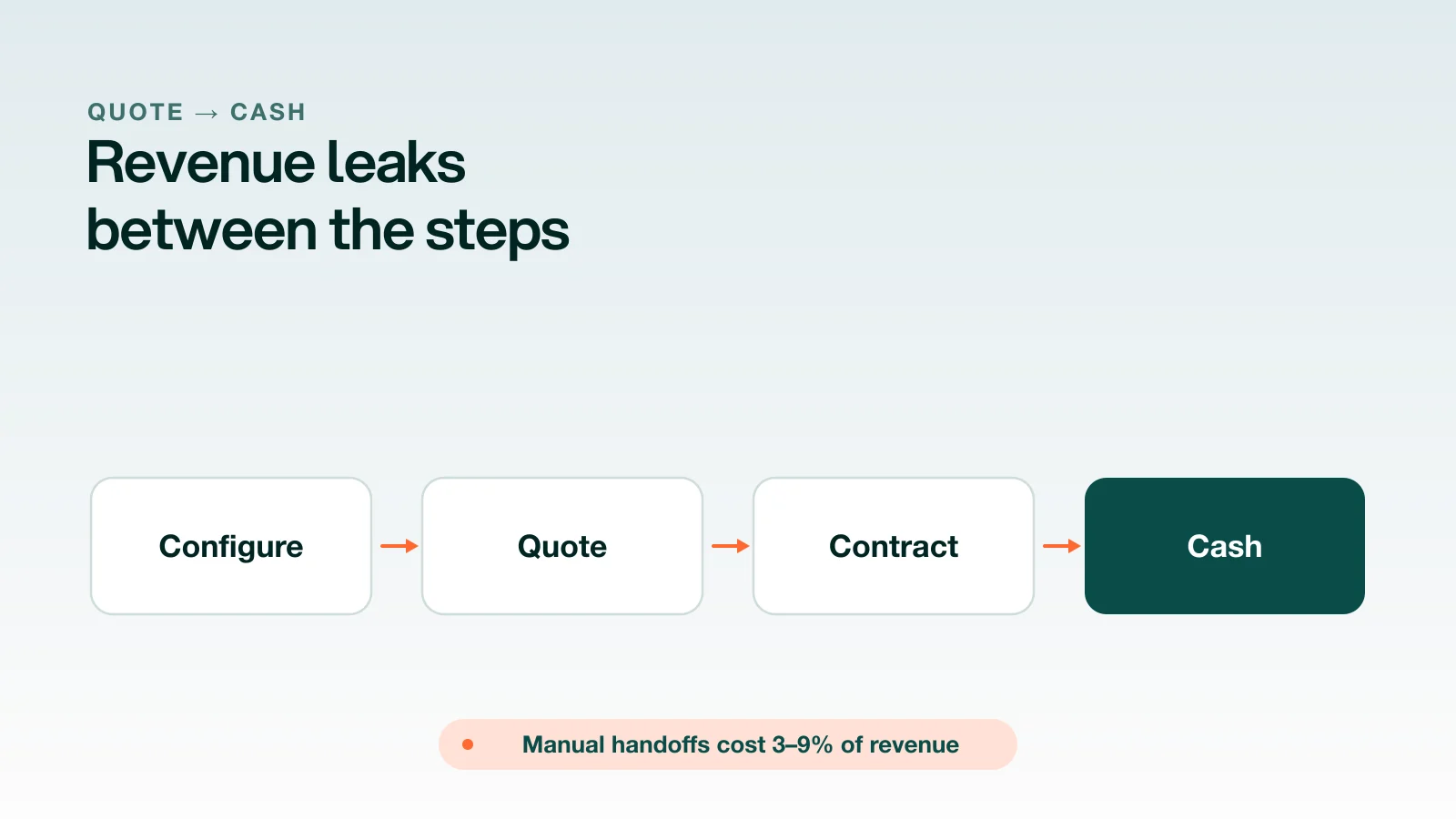
Quote-to-cash covers the full path from quote to paid invoice — most losses happen not within a single step, but at the handoffs between them.
- An estimated 42% of companies experience revenue leakage, losing between 1-5% of annual revenue, with some sources citing 3-9%.
- Pricing drift alone drives roughly 38% of total leakage value, according to current benchmark data.
- Manual work can tie up to 50% of sales time across the entire quote-to-cash process.
- The most common cause of delays and revenue loss sits at the handoffs between CRM, billing, and ERP — not inside any single system.
Table of contents
- What is quote-to-cash?
- The steps in the quote-to-cash process
- Quote-to-cash is not the same as CPQ
- Manual vs. integrated quote-to-cash process compared
- Quote-to-cash in practice: where revenue actually gets lost
- Why quote-to-cash needs agentic support now
- FAQ
What is quote-to-cash?
Quote-to-cash (Q2C) is the full business process from initial quote configuration to payment received: configuration, pricing, quote generation, contract closing, order fulfillment, invoicing, and payment tracking. For industrial companies with complex, configurable products, this process is rarely linear — it typically runs through multiple systems and departments, from sales through order fulfillment to finance.
The steps in the quote-to-cash process
- Configure & price — product configuration and pricing logic (the CPQ part of the process).
- Quote — generating the formal proposal.
- Contract — closing the deal and getting approvals.
- Order fulfillment — usually handled in the ERP system.
- Invoice — billing based on the final agreement.
- Cash — payment received and reconciled.
Quote-to-cash is not the same as CPQ
CPQ is a sub-process within quote-to-cash and only covers configuration, pricing, and quote generation. Quote-to-cash goes considerably further, additionally covering contract management, order fulfillment, invoicing, and payment tracking. A company can have a strong CPQ system and still lose revenue elsewhere in the Q2C process — for example, in the handoff from contract to invoice.
Manual vs. integrated quote-to-cash process compared
| Criterion | Manual, fragmented process | Integrated quote-to-cash process |
|---|---|---|
| Revenue lost to leakage | 1-9% of annual revenue depending on source | significantly reduced through consistent data across steps |
| Handoffs between systems | manual, error-prone | automated across CRM, billing, and ERP |
| Pricing consistency | vulnerable to pricing drift | derived from a single source throughout |
| Sales time spent | up to 50% tied up in manual work | sales focused more on customer conversations |
| Traceability | hard to reconstruct where value was lost | traceable end-to-end from quote to payment |
Quote-to-cash in practice: where revenue actually gets lost
In practice, the biggest losses rarely come from obvious mistakes — they come from small discrepancies at the handoffs: a special discount noted on the quote but not carried correctly into the invoice; a contract change that never gets synced back to the ERP. Individually, these discrepancies look small — across a year and many deals, they add up to a meaningful share of revenue.
Why quote-to-cash needs agentic support now
In practice, AI platforms like Genow already do this by actively monitoring the handoffs between Q2C steps: catching discrepancies between the agreed quote and the final invoice before it goes to the customer, and surfacing inconsistencies between CRM and ERP data instead of only spotting them at quarterly reconciliation. This closes the gap between existing systems, exactly where the data shows most leakage originates.
FAQ
What does quote-to-cash mean in simple terms?
The entire business process from the first quote to payment received, including configuration, contract, order fulfillment, and invoicing.
What's the difference between quote-to-cash and CPQ?
CPQ only covers configuration, pricing, and quote generation. Quote-to-cash additionally covers contract closing, order fulfillment, invoicing, and payment.
Where does most revenue get lost in the quote-to-cash process?
At the handoffs between systems and departments — for example between quote and invoice, or between CRM and ERP — rather than typically within a single step.
How much revenue do companies lose to revenue leakage?
Estimates range from 1-5% up to 3-9% of annual revenue, depending on industry and process maturity.
Does quote-to-cash software replace the ERP system?
No. It connects and orchestrates process steps that today often run fragmented across CRM, CPQ, and ERP, but it doesn't replace any of those systems.
Is quote-to-cash optimization worth it for smaller industrial companies too?
Yes, especially when many configurable products, special terms, or complex contract structures are involved — that's where leakage risk is highest.
Can AI automatically catch revenue leakage in the quote-to-cash process?
AI tools such as Genow can surface discrepancies between quote, contract, and invoice before they turn into lost revenue, helping sales and finance act on them faster.