What Is a Sales Battlecard? Structure, Examples, and Why Most Go Unused
Teams with battlecards win 23% more competitive deals, yet only 26% of reps use them. Structure, examples, and what makes the difference in the field.
Key takeaways
A sales battlecard packages competitive knowledge for reps — but its value is decided by usage in the room, not by how well it was written.
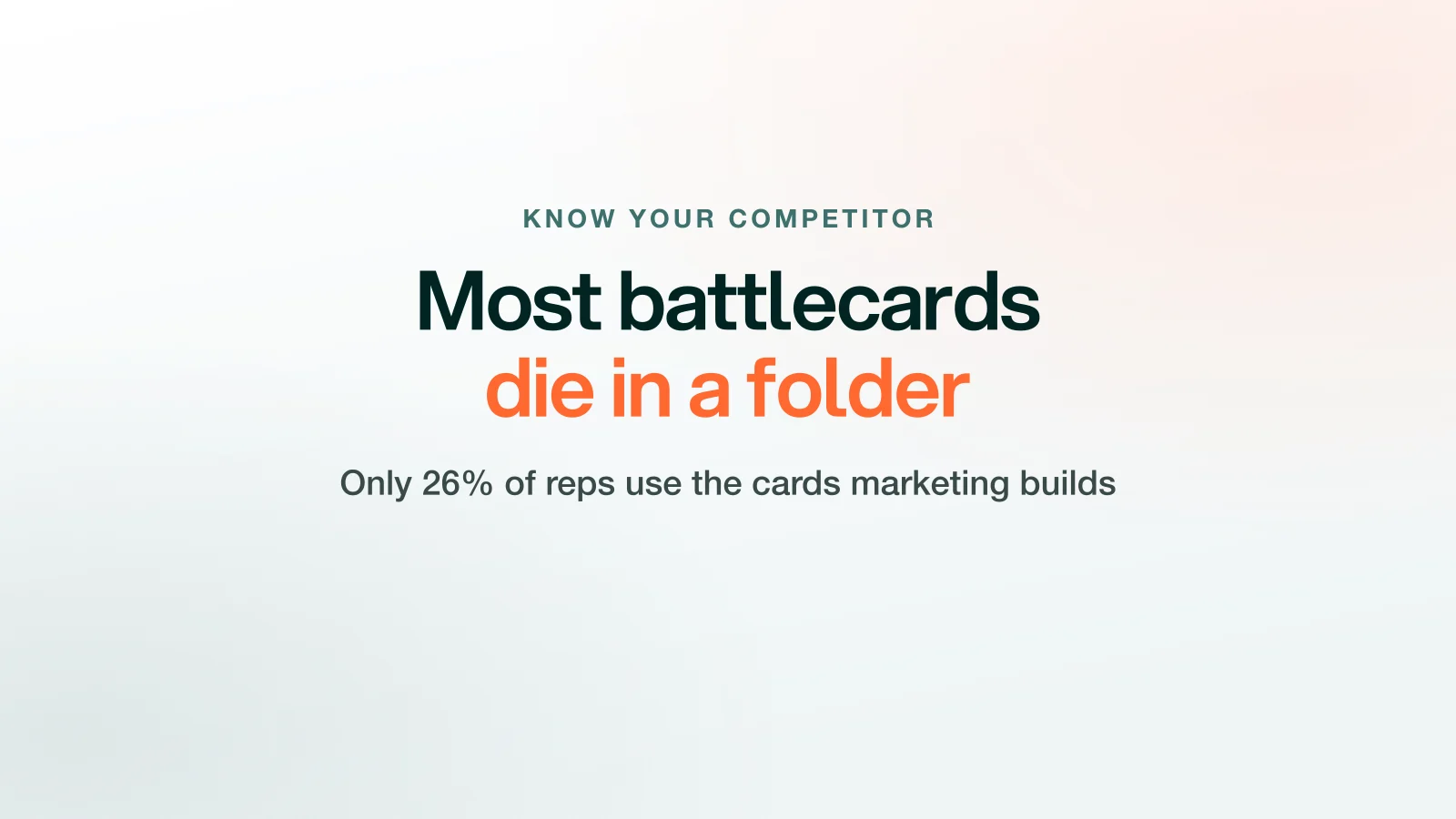
- Teams with battlecards win 23% more competitive deals, yet only 26% of reps actually use the battlecards built for them.
- 68% of all sales opportunities are now competitive, and competitive mentions in deals are up 57% since 2022.
- Only 29% of reps feel adequately informed about competitors — the gap is rarely missing knowledge, it’s outdated or hard-to-find battlecards.
- 71% of companies using battlecards report improved win rates, and 93% of those see improvements exceeding 20%.
Table of contents
- What is a sales battlecard?
- What belongs in a good battlecard?
- Battlecard vs. sales playbook
- Static vs. living battlecard compared
- Battlecards in practice: maintenance beats creation
- Why battlecards need to be maintained agentically now
- FAQ
What is a sales battlecard?
A sales battlecard is a compact reference reps use mid-conversation to respond to a specific competitor or common objection — typically covering strengths, weaknesses, pricing position, and pre-built counterpoints. The goal isn’t completeness, it’s speed: a battlecard should be findable and usable in seconds, not another internal document nobody reads.
What belongs in a good battlecard?
A working battlecard typically includes:
- Competitor snapshot — positioning, target audience, known strengths.
- Where we win / where we lose — honest, not sugarcoated.
- Common objections and counterpoints — phrased concretely, ready to use in conversation.
- Price and package comparison, where publicly available.
- Proof points — references, numbers, case examples that back the position.
Battlecard vs. sales playbook
Battlecards and sales playbooks get confused often, but they serve different needs. A sales playbook describes the entire sales process — stages, methodology, ownership. A battlecard is a single, situational tool within that process, triggered exactly when a specific competitor or objection comes up in conversation. A good playbook points to the right battlecard at the right moment — it doesn’t replace it.
Static vs. living battlecard compared
| Criterion | Static battlecard (PDF) | Living, agentically maintained battlecard |
|---|---|---|
| Freshness | often stale within weeks | continuously updated from new product and market data |
| Findability | separate file, easily forgotten | accessible directly in the workflow |
| Usage rate | only 26% of reps actively use it | rises when retrieval requires no extra search effort |
| Maintenance effort | manual, usually on product marketing | partly automated through continuous data monitoring |
| Rep trust | drops once content is seen as outdated | stays high when content is demonstrably current |
Battlecards in practice: maintenance beats creation
Most battlecard programs don’t fail at version one — they fail at the second update. A competitor changes their pricing structure, a new feature ships, and the battlecard stays frozen until nobody trusts it anymore. In practice, once a battlecard has been experienced as outdated, reps tend to avoid it permanently, even after it’s refreshed.
Why battlecards need to be maintained agentically now
AI platforms like Genow make exactly this possible: continuously cross-checking battlecard content against current product data, technical specs, and internal sales feedback instead of waiting for a manual quarterly refresh. That turns the battlecard from a static document into a continuously current knowledge source, retrievable exactly when it’s needed mid-conversation, making sure the competitive analysis behind it actually reaches the sales floor.
FAQ
What is a sales battlecard in simple terms?
A compact conversation aid for reps with competitor information, a strengths/weaknesses comparison, and pre-built counterpoints for direct use in customer conversations.
Why don't many reps use their battlecards?
Usually because the content is outdated, hard to find, or not retrievable in the actual flow of conversation — not because the format itself doesn't work.
How often should a battlecard be updated?
Ideally continuously rather than on a fixed cycle, since competitor positioning, pricing, and product features change throughout the year.
Is a battlecard the same as a sales playbook?
No. The playbook describes the entire sales process; the battlecard is a situational tool for specific competitive moments within that process.
Does every company need battlecards?
Especially relevant for companies with competitive, technically complex sales processes — such as industrial and equipment sales, where product detail decides who wins the deal.
Can AI build battlecards automatically?
Genow Sales Cowork can keep content continuously current from product data, technical documentation, and market information, helping the sales and product team turn strategic positioning into action faster.