Generic AI Chat vs. Real Product Matching: Why 'Chat With Your Docs' Reaches Its Limits in Complex Sales
Generic AI assistants are great for general questions but reach their limits on the product decision in a complex portfolio.
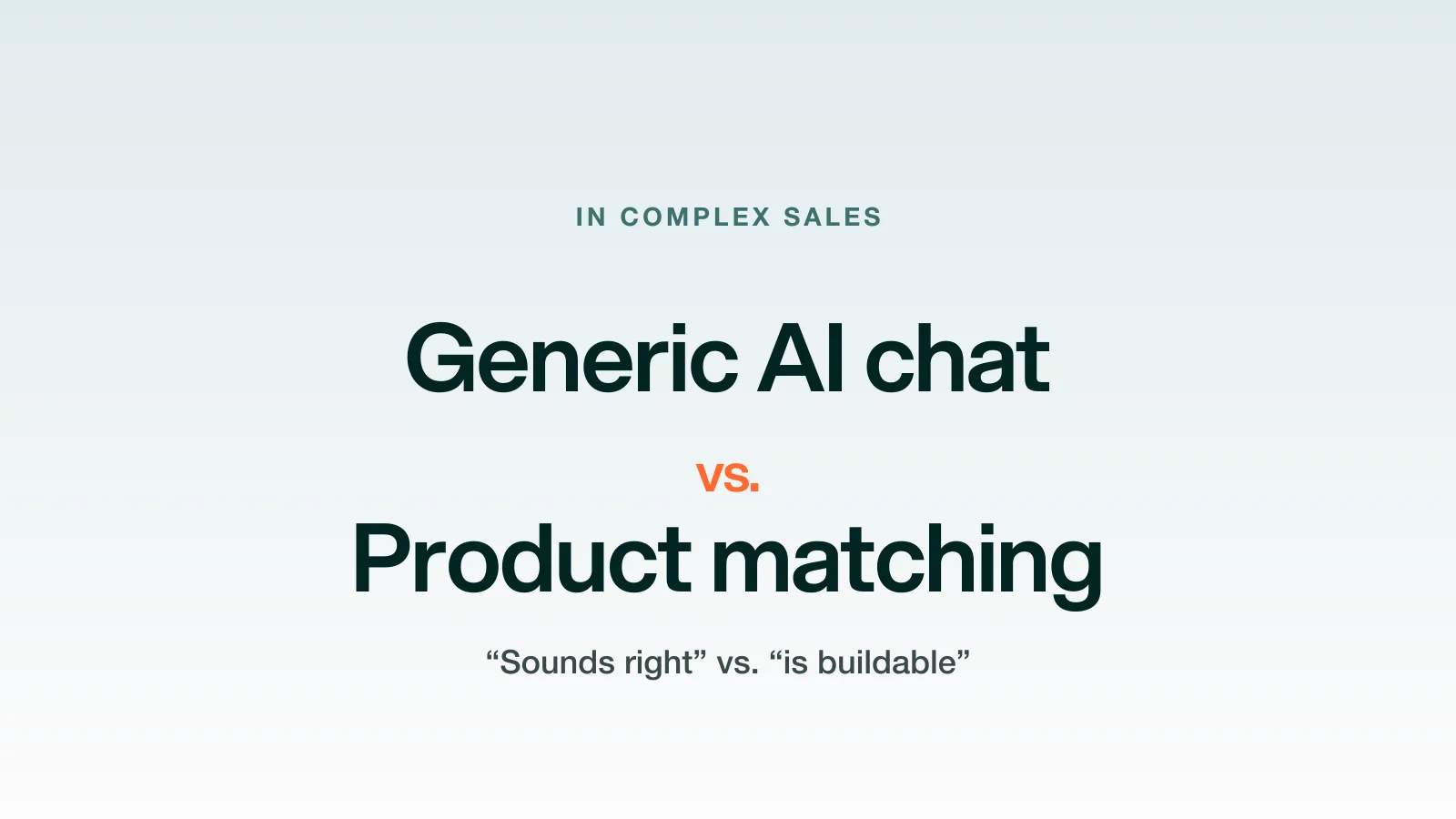
Generic AI chat (“chat with your documents,” e.g. Copilot or ChatGPT) searches text and phrases plausible answers – but on the product it isn’t bound to validity rules. Real product matching navigates the actual portfolio: it checks against the options/variants database with validity rules and returns valid, buildable products with reasoning. In selling complex goods, that’s the difference between “sounds right” and “is buildable.”
Why “chat with your docs” looks tempting
A generic assistant over company data is quick to set up and answers many questions usefully. For finding a phone number or a policy, that’s enough. But in selling tailored products, the real question isn’t “what does the datasheet say?” – it’s “which product, from tens of thousands of variants, fits this requirement, and is it even buildable?”
Where generic chat reaches its limits
-
It lacks product grounding: language models produce plausible answers, but without the validity rules an unbuildable recommendation can slip through.
-
It doesn’t know validity: whether an option fits a product lives in an options database with rules – not in a PDF.
-
Plausible isn’t buildable: in a manufacturing context that matters – a non-buildable offer costs trust and margin.
-
It stays siloed: a chat returns text, not the end-to-end deal workspace with matching, arguments, and materials.
On top of that, the market has shown that against this generic “chat with your data” promise, business units want a dedicated, outcome-focused solution – not a horizontal capability.
What real product matching does differently
Genow is connected not to documents alone but additionally to the custom options/variants database with its validity rules, to price lists, and to research across public competitive sources. The agent navigates the real portfolio and delivers the buildable product – with visible reasoning. Where certainty is missing, it says so and routes to engineering instead of bluffing.
| Dimension | Generic AI chat | Real product matching (Genow) |
|---|---|---|
| Data basis | Documents/text | Documents + options DB + rules + prices |
| Product choice | Guessed/plausible | Valid & buildable, checked against rules |
| Reasoning | Often generic | “Fits because …” with sources |
| Failure mode | Confident-but-wrong | Honest uncertainty → escalation |
| Scope | Answer text | End-to-end deal workspace |
Connected, not migrated
Another difference: Genow connects to existing systems instead of migrating data into a new platform. So it uses exactly the non-public, hard-to-search options database a generic chat can’t meaningfully exploit – and turns it into a selling advantage.
When a generic chat is still enough
To be fair: for general knowledge questions, drafting text, or simple research, a generic assistant is useful and often already in place. The boundary is the product decision in a complex portfolio. There you need grounding in validity rules – and that’s exactly where “chat with your docs” reaches its limits in complex sales.
FAQ
Where do ChatGPT or Copilot reach their limits in sales?
Generic assistants are great for general questions, but they aren't bound to the portfolio's validity rules – the product decision in a complex portfolio isn't their core field. Real product matching checks against the options database and is built to return valid products.
What's the main difference from product matching?
Generic chat doesn't know validity. Genow navigates the real portfolio against validity rules and justifies the choice with sources.
Is a confident-but-wrong suggestion really that critical?
In manufacturing, yes: a non-buildable or non-compliant offer costs trust, time, and margin. That's why grounding and honest uncertainty are central.
So we don't need a generic assistant at all?
For general questions and drafting it stays useful. For the product decision in a complex portfolio you need real, rule-checked matching.