Top 5 Strategies to Build an Effective Sales Argument
How sales teams build sales arguments that hold up, instead of meeting objections with stock phrases — 5 concrete strategies.
Key takeaways
An effective sales argument doesn’t come from a generic script — it comes from concrete proof points tailored to the customer in front of you.
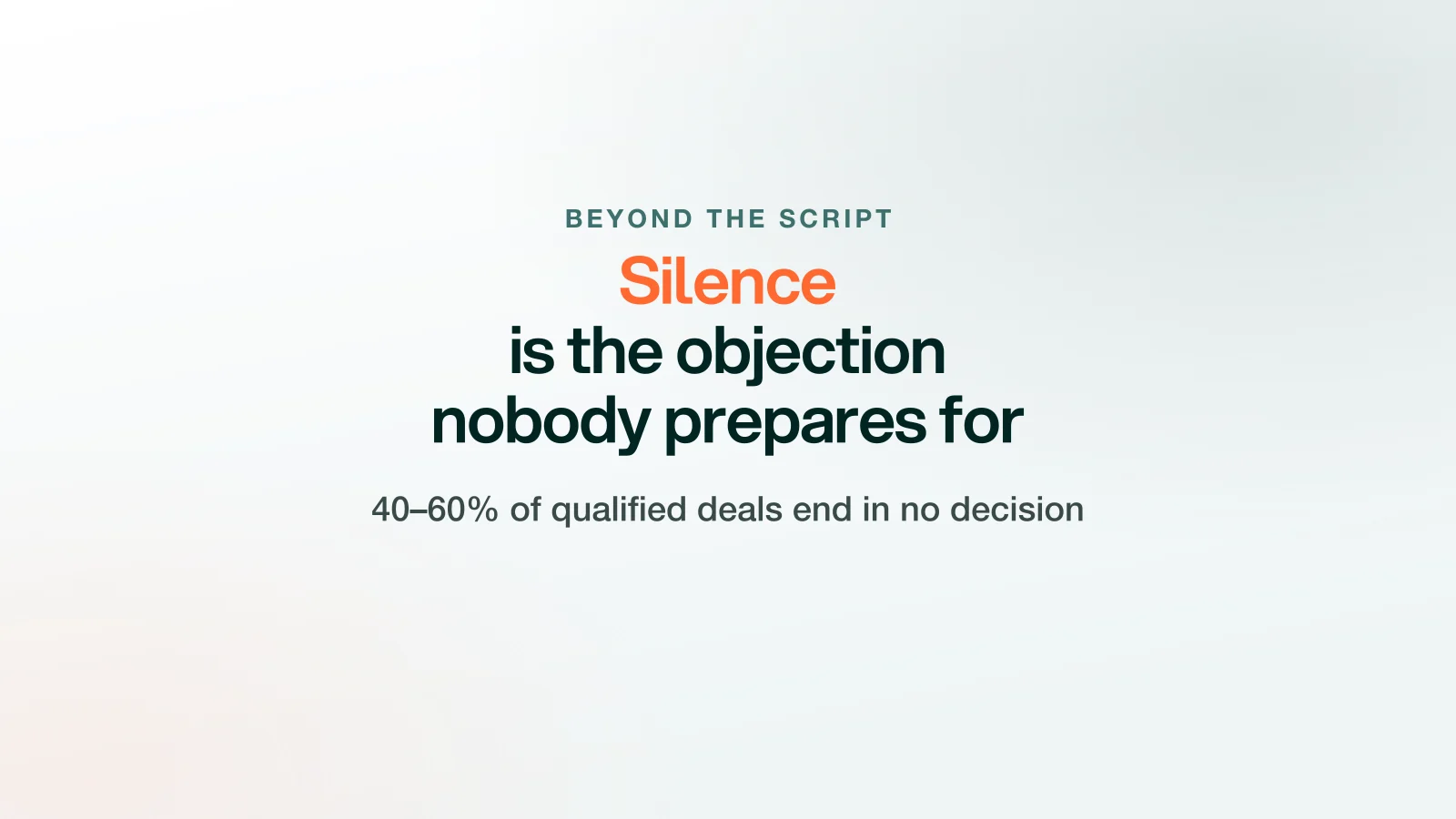
- 40–60% of all qualified deals don’t end on a stated objection — they end in “no decision,” the most expensive and least-prepared-for outcome.
- Win rates are down 18% versus 2022, and only 43.5% of reps currently hit quota.
- Deals closed within 50 days win at a 47% rate — after 50 days, that drops to 20% or lower.
- Teams that consistently inspect deals against a defined process hit quota at 6.3 times the rate of those that rarely do.
Table of contents
- Why most sales arguments stay too generic
- 5 strategies for an effective sales argument
- Sales argument vs. objection handling
- Generic vs. context-based argument compared
- Sales arguments in practice: the silent objection
- Why strong arguments need knowledge access now
- FAQ
Why most sales arguments stay too generic
A sales argument is the concrete reason a customer should buy from this vendor — ideally backed by numbers, references, and a clear link to what the customer actually needs. The problem in practice: most arguments stay generic because they’re built around product benefits instead of the customer’s specific situation. An argument that sounds the same for every customer ends up convincing no one.
5 strategies for an effective sales argument
- Start from the customer’s actual use case, not the feature list — the argument has to anchor to a real problem.
- Use hard numbers instead of superlatives — “cuts quoting time by 36%” lands harder than “revolutionary.”
- Address the silent objection directly — if a customer shows no resistance but also isn’t deciding, ask instead of waiting it out.
- Use references from comparable situations, not generic success stories.
- Tie the argument to a concrete next step — a strong argument with no clear next step just dissipates inside the customer’s decision process.
Sales argument vs. objection handling
Objection handling reacts to resistance the customer has already voiced. A sales argument, by contrast, is proactive: it builds the vendor’s position before an objection even forms. The two belong together but aren’t the same — a team that only trains objection handling, without building a foundational argument, spends the whole conversation reacting instead of leading.
Generic vs. context-based argument compared
| Criterion | Generic argument | Context-based argument |
|---|---|---|
| Starting point | product features | the customer’s actual use case |
| Evidence | generic success stories | numbers and references from comparable situations |
| Effect on silent objections | usually ignored | creates a concrete reason to re-engage |
| Prep effort | low, but weak impact | higher, but far more persuasive |
| Reusability | high, but interchangeable | needs adapting per situation |
Sales arguments in practice: the silent objection
The most expensive objection is often the one that’s never spoken. A customer who shows no concrete resistance but also isn’t deciding rarely gets a mention in most objection-handling training — yet 40–60% of all qualified deals end exactly that way. In practice, no pre-written counterpoint fixes this; what helps is the ability to ask targeted questions that surface the real uncertainty underneath.
Why strong arguments need knowledge access now
A convincing, context-based argument needs fast access to the right reference, the right number, the right technical detail — exactly at the moment the conversation calls for it. Genow’s AI agents know not just the product data, past deals, and technical documentation, but also the company’s communication style, and can turn that into a ready-to-use argument instead of leaving reps to piece the building blocks together themselves.
FAQ
What is a sales argument in simple terms?
The concrete, evidenced reason a customer should buy from this vendor specifically — tailored to their actual situation, not a generic product promise.
What's the most expensive objection in sales?
The silent objection: a customer who neither clearly rejects nor decides, letting the deal end in "no decision" — according to the data, the most common reason qualified deals are lost.
How is a sales argument different from objection handling?
Objection handling reacts to stated resistance; a sales argument proactively builds the vendor's position before an objection ever forms.
How much does speed matter to an argument's effectiveness?
A lot: deals closed within 50 days win at meaningfully higher rates than deals that drag on.
Can sales arguments be standardized?
Only partly — the basic structure can be standardized, but the specific evidence and the link to the customer need to be adapted per situation.
What role does product knowledge play in a strong argument?
A central one: without fast access to concrete technical detail and references, any argument stays at the level of general statements.
Can AI help build a sales argument?
Yes — Genow Sales Cowork doesn't just know the product portfolio, it also has context on the company's communication style. That means it can draft a ready-to-use sales argument directly, not just surface the right reference or number.