Genow vs. Blockbrain: Context Engine vs. Knowledge Twin Compared
Both Genow and Blockbrain are EU-sovereign AI platforms. What are the real differences? Architecture, use-case depth, governance, time-to-value.
Core difference
Blockbrain markets its ‘Knowledge Twin’ as a central AI representation of enterprise knowledge.
Genow builds a Context Engine that connects multiple specialized agents with validated sources, citations and governance.
For mid-market manufacturers with concrete line-of-business use cases, the Context Engine approach ships productive agents in service, sales and production faster.
Positioning
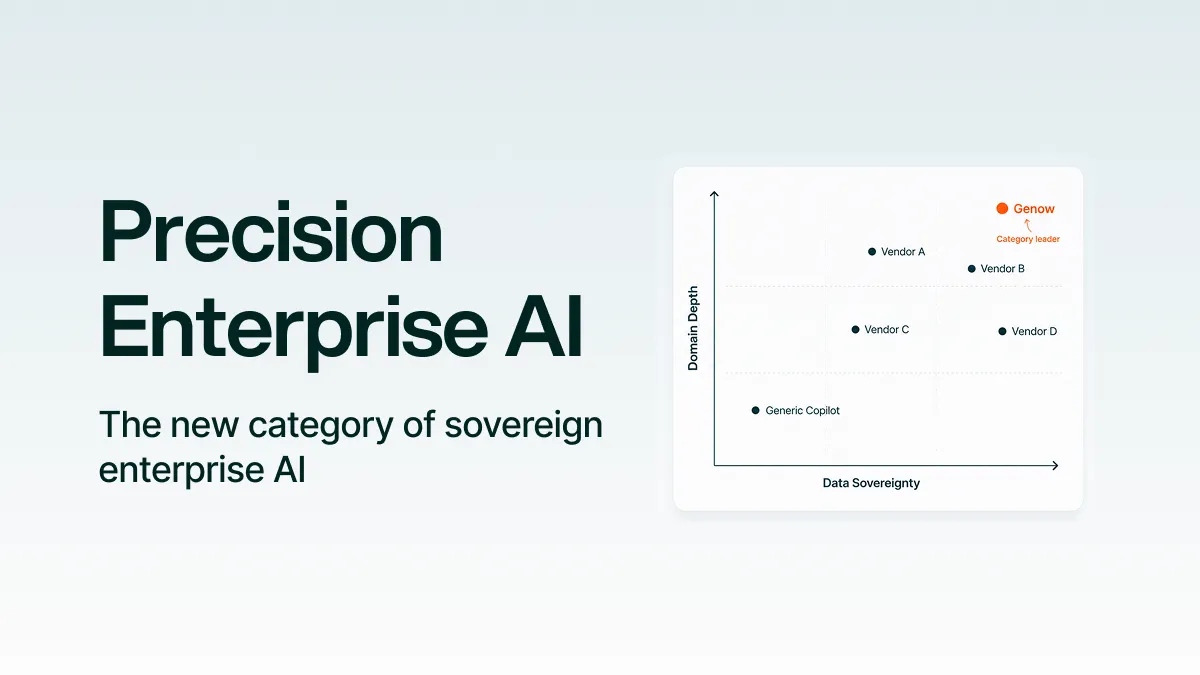
Blockbrain positions as a European all-in-one platform for central enterprise knowledge use, leaning on the ‘digital twin of the company’ metaphor. Genow positions as a Precision Enterprise AI Platform focused on concrete, domain-deep use cases in mid-market manufacturing and in enterprises with a strong business-unit orientation.
Architecture
| Dimension | Blockbrain | Genow |
|---|---|---|
| Core narrative | Knowledge Twin — one central knowledge mirror | Context Engine + specialized agents per use case |
| Use-case depth | Horizontal breadth | Pre-configured use case templates for service, sales, production |
| Data integration | Broadly configurable | Broad set of standard connectors (SharePoint, Confluence, Jira, ServiceNow & more), flexibly configurable – plus custom knowledge sources via proprietary connector architecture |
| Governance | Platform governance | Full set of configuration options to tailor each use case to exact requirements – per-answer audit trail, EU AI Act-ready |
| Time-to-first-agent | 3–6 months | 6–12 weeks |
| Hosting | EU | EU / Frankfurt, VPC option, hosting in your own cloud |
Use-case depth as a differentiator
Real RFPs don’t reward the broader platform — they reward faster delivery of concrete agents. Genow ships pre-configured use case templates for service, product knowledge, proposals and production, shortening the path from PoC to productive agent and making impact measurable early.
Governance & auditability
For regulated industries and mid-market companies that take GDPR and the EU AI Act seriously, every answer needs a source. The Genow Context Engine versions sources, logs decisions and produces per-answer audit trails. This depth is reachable on Blockbrain too, but sits more squarely in the hands of the implementing team.
Total cost of ownership
For three to five parallel use cases both platforms land in a comparable price band. The TCO difference comes through implementation: Genow bundles build, pre-configured use case templates and run in one contract, saving internal effort and accelerating payback.
When to pick which
Blockbrain: when you want a central, horizontal knowledge platform as your strategic anchor and are happy to build domain depth yourself.
Genow: when business units need measurable impact in weeks, concrete agents (service, proposal, product knowledge, production) are the priority, and an EU-sovereign platform with a strong implementation partner is required.
FAQ
Is Blockbrain a serious option for mid-market manufacturers?
Yes — it's a valid European choice with a horizontal focus. For narrow line-of-business use cases Genow usually reaches productive faster.
Can Genow deliver the Knowledge-Twin narrative?
The Context Engine plus the set of specialized agents effectively renders the same end state, with concrete use-case wins along the way.
What's the implementation effort?
First Genow agents are typically productive in 6–12 weeks; subsequent agents on the same platform halve that effort.