The Dark Long Tail: Why Reps Sell Only a Fraction of Your Catalog
No human can know tens of thousands of variants – the higher-margin product stays on the shelf. How requirement-to-product matching unlocks the long tail.
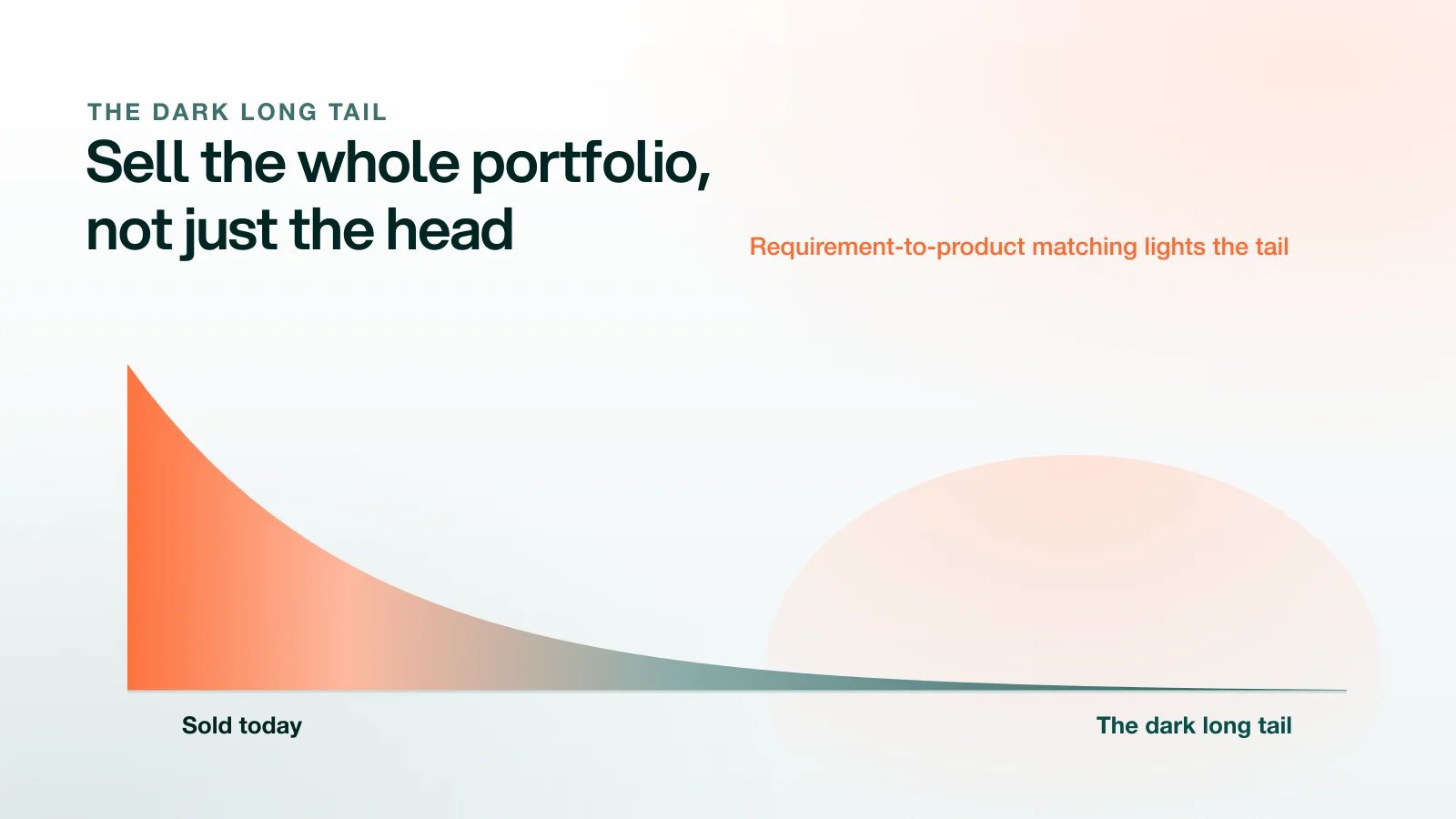
The “dark long tail” describes the bulk of a complex product portfolio that reps never actively sell, because no one can hold tens of thousands of variants in their head. The familiar head of the curve gets sold; the right – often higher-margin or better-fitting – product in the tail stays on the shelf. Requirement-to-product matching unlocks that long tail by having an agent match every requirement against the full, rule-checked portfolio.
What the dark long tail is
In a large, combinatorial catalog, a rep can confidently sell only a small part – the products they know well. The rest of the portfolio is effectively dark: present, but invisible in day-to-day selling. The larger and more variant-rich the catalog, the bigger that shadow.
This isn’t a motivation problem but a memory problem. With tens of thousands of options governed by validity rules, it’s simply impossible to have the objectively best product ready for every customer requirement. So reps reach for the familiar – and leave margin and fit on the table.
What the dark long tail costs
-
Forgone margin: the higher-margin product in the tail is never offered.
-
Worse fit: the customer gets the familiar product instead of the objectively best one.
-
Lost deals: where fit is off, the competitor wins.
-
Expert bottleneck: as soon as it gets atypical, the rep escalates to the scarce department (~1 expert per 10 reps).
Add the time factor: reps sell only around 28–30% of their time; much of it goes to searching and prep. Anyone who must laboriously assemble the right product rarely reaches the long tail – they stay with the obvious.
Why existing tools don’t light the tail
Classic guided selling (question trees) doesn’t scale across thousands of variants. CPQ configures only once it’s clear what to build – it doesn’t help with which product even fits. And a generic AI chat guesses at the product without knowing the validity rules. The dark long tail stays untouched.
How requirement-to-product matching unlocks the tail
Genow matches every requirement – conversation, email, spec – against the full portfolio: product knowledge, the options/variants database with validity rules, and price lists. The agent considers not just the familiar 5% but the whole catalog, and proposes the valid, best-fitting product – with reasoning. That makes the tail of the curve sellable.
| Without matching | With requirement-to-product matching |
|---|---|
| The familiar head of the curve gets sold | The whole portfolio is considered |
| Higher-margin variants stay on the shelf | The objectively best, valid product reaches the offer |
| Atypical inquiries escalate to experts | The agent matches; the expert resolves only the new cases |
| Competitor wins on poor fit | Better fit raises win probability |
Turning a liability into an advantage
The non-public, hard-to-search options database is often a liability today – costly to maintain, barely accessible. Once an agent can navigate it, it becomes a selling advantage competitors can’t easily copy. In live deployments, the agent makes tens of thousands of valid options usable for every rep – the long tail turns from shadow into catalog.
This is the self-recognition message of the new positioning: “The right product from a range no one can fully know.” Lighting the dark long tail doesn’t mean selling more – it means selling better, and selling the right thing.
FAQ
What does “dark long tail” mean in sales?
The bulk of a complex portfolio reps never actively sell because no one can know tens of thousands of variants. The familiar head of the curve gets sold; the rest stays invisible.
Why is it a problem?
It costs margin and fit: the objectively best, often higher-margin product is never offered, and where fit is off, the competitor wins.
Why don't CPQ or generic AI solve it?
CPQ configures only after the product choice; generic chat guesses without validity rules. Neither unlocks the full portfolio from the requirement.
How does Genow unlock the long tail?
Through requirement-to-product matching: the agent matches every requirement against the whole, rule-checked portfolio and proposes the valid, best-fitting product – with reasoning.