7 AI Use Cases in Industrial Sales in 2026
From product matching to buyer self-service: seven concrete AI use cases in industrial sales – each with problem, solution, benefit, and a Genow example.
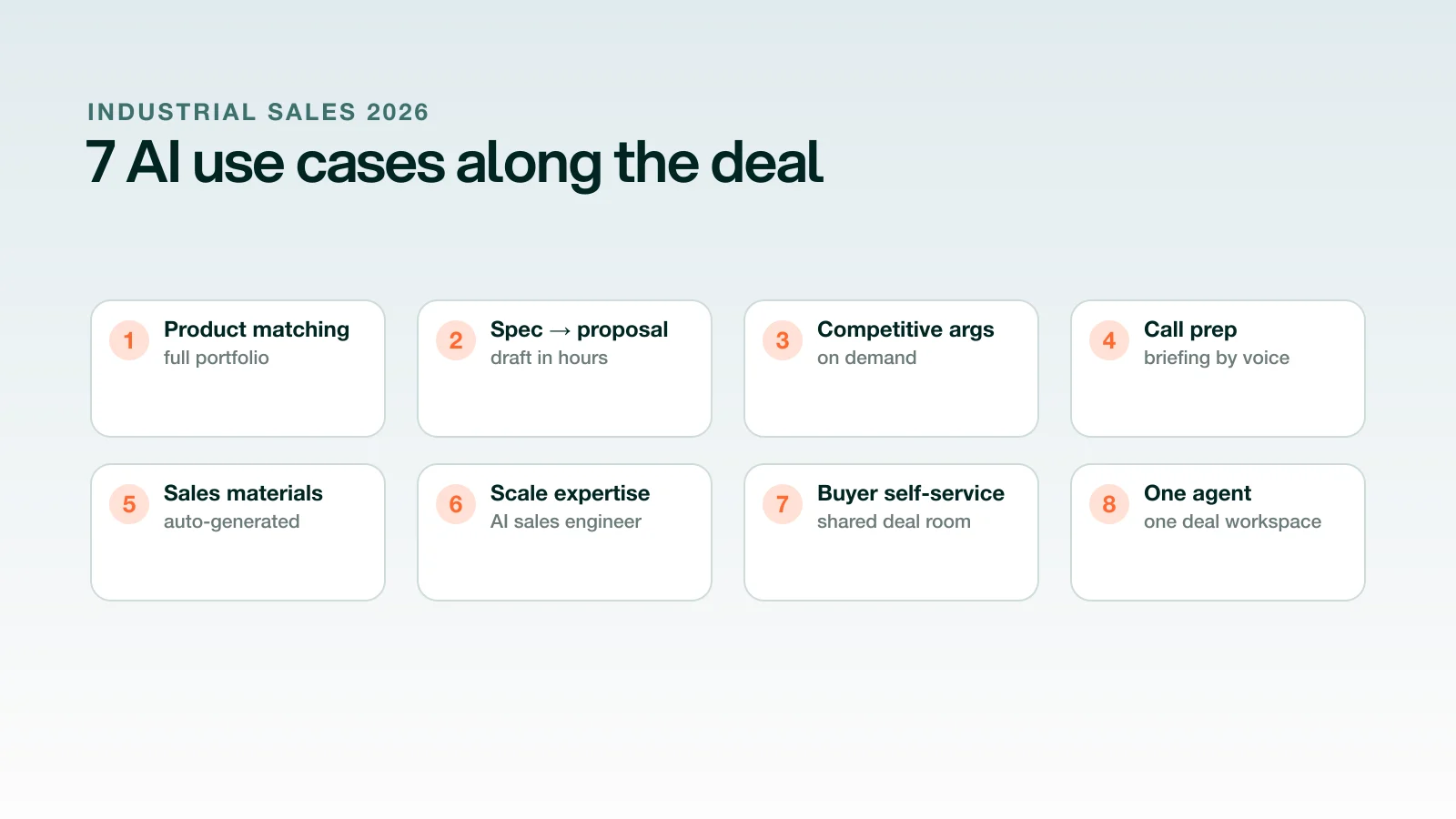
The most effective AI use cases in industrial sales in 2026 sit along the deal: (1) product matching, (2) spec→proposal, (3) competitive arguments on demand, (4) call prep, (5) personalized sales materials, (6) scaling expert knowledge, and (7) buyer self-service. Together they address the core problem: reps sell only ~28–30% of their time – AI gives that time back and makes the whole portfolio sellable.
33% of field-sales teams use no AI at all, and fewer than 20% use it for the higher-value tasks – so the seven use cases below are early, not late.
1. Find the right product from the whole portfolio
Problem: no one knows tens of thousands of variants; the higher-margin hit in the long tail stays on the shelf. Solution: requirement-to-product matching checks the requirement against product knowledge and the options database (with validity rules) and returns the valid product with reasoning. Benefit: more portfolio sold, better fit, fewer escalations. Genow example: in live deployments, the agent makes tens of thousands of valid options usable for every rep and actively recommends components with a higher margin.
2. From spec to proposal draft
Problem: 70–80% of answers sit in old proposals but take days to assemble. Solution: the agent structures the spec/RFP, matches it against history and product knowledge, and builds the draft. Benefit: proposals in hours instead of days – one of manufacturing’s most time-consuming stages shrinks. Genow example: tender or 50-page spec in, complete draft out, with reps only refining it.
3. Competitive arguments on demand
Problem: only ~26% of reps use static battlecards. Solution: the agent combines current competitor research with product knowledge and the specific requirement and delivers the fitting argument in the deal context. Benefit: good competitive arguments lift win rates by ~20–30% – when they’re used. Genow example: Manufacturers of complex products use Genow to create customer- and industry-specific sales arguments and to automate competitive research.
4. Call prep & briefing
Problem: many reps lack time for proper research (Cirrus Insight: ~65%) – they read LinkedIn in the car and build comparisons in Excel. Solution: the agent proactively builds a briefing on the company, decision-makers, and competition, available by voice. Benefit: personalized conversations without prep overhead. Genow example: briefing on demand from the deal workspace, usable on the road.
5. Generate personalized sales materials automatically
Problem: content creation is the biggest productivity gap per studies (84% of leaders). Solution: from the right product, fitting arguments, and correct prices, the agent generates personalized materials – as PPTX, PDF, email, or into the CRM. Benefit: less formatting, more selling. Genow example: Sales reps request deal materials from the agent via voice and receive optimized, ready-to-use materials directly in their workspace.
6. Scale scarce expert knowledge
Problem: there’s ~1 application engineer per 10 reps – every special question escalates and slows the deal. Solution: the AI sales engineer answers routine product questions against the validity rules and hands only the genuinely new cases to the expert, natively and with full context. Benefit: the expert resolves the 5% new cases instead of the same question 50×. Genow example: Forwarding special requests to experts with full deal context and directly answering over 95% of inquiries from the sales team.
7. Inform the buyer self-service (share the deal workspace)
Problem: buyers want fast answers without waiting for the next meeting. Solution (add-on): the rep shares a scoped buyer room via link/QR; the buyer asks the same agent about the released materials, and the questions flow back as intent signal. Benefit: faster evaluation, real question-intent instead of click analytics.
Takeaway
The seven use cases are not a random collection of tools, but stages of a deal—covered by one agent in a deal workspace. Companies that get started in 2026 are entering at exactly the right time. The technology finally enables automation and end-to-end support for sales teams preparing complex deals.
FAQ
Which AI use case is worth doing first?
Product matching (Use Case 1) solves a core challenge in the sales process: automatically identifying the right product from the entire portfolio. The additional use cases then make it possible to position that product convincingly with the customer.
Are these seven separate tools?
No. All seven run through one agent in one deal workspace. That lowers rollout and adoption effort and keeps the data in the same context.
How fast do you see results?
With the “connected, not migrated” approach, matching is live from day 1; a first product family can be in daily use in about 60 days.
Is the buyer room already standard?
No. Use case 7 is deliberately positioned as a later add-on; the entry point is product matching, not buyer self-service.