Why do I need a Use Case scorecard?
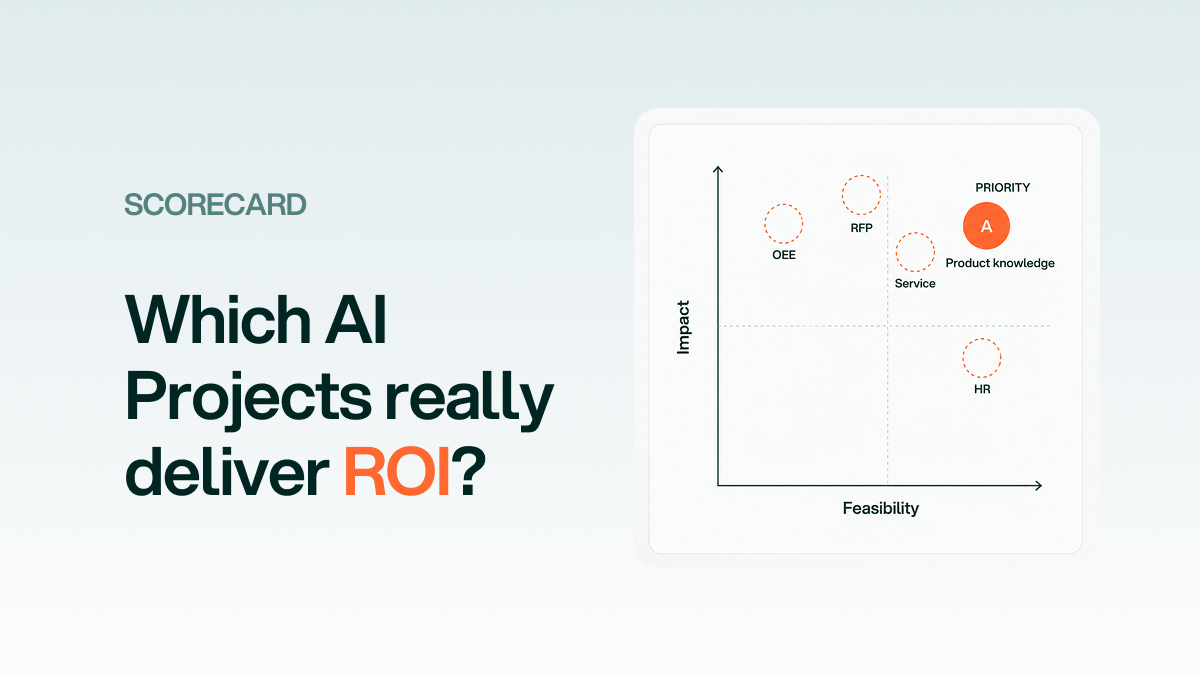
Because mid-market AI projects don't usually fail on the model — they fail on the wrong Use Case. The scorecard forces the buying center to weigh impact, feasibility, data readiness, time-to-value and ROI side by side before budget moves.
Scorecard structure
Five dimensions scored 1–5: business impact, feasibility, data readiness, time-to-value, ROI estimate. Weighted sum yields a priority score. Two traffic-light flags: compliance risk and executive sponsorship.
Typical patterns
Service agents: high impact, medium feasibility, mature data, fast TtV — usually rank 1.
Proposal / RFP agents: very high impact, moderate feasibility, data partially structured.
Product-knowledge agents: high impact, high feasibility, data mostly in PIM or SharePoint.
HR agents: medium impact, high feasibility, fast TtV, low euro ROI — but strong adoption lever.
Production / OEE agents: very high impact, more demanding feasibility due to MES integration.
How to run the scorecard
In a half-day workshop with IT, business and finance. Score three to six candidates. Lock the top two and push them into the 90-day playbook.
Integration with the 90-day playbook
The scorecard feeds week 1 of the 90-day playbook. A clear Use Case score cuts pre-work and forces early KPI alignment. Now that the groundwork has been laid internally, you can create a knowledge agent on the Genow platform in just a few clicks and immediately take advantage of its highly precise search capabilities.
Common prioritisation mistakes
Use Case chosen by the vendor, not the company — leads to platform pilots without business focus.
Feasibility overrated, data readiness underrated.
ROI kept qualitative — no numbers, no political cover.
Using a centralized knowledge platform such as Genow helps eliminate additional risk factors that could lead to the failure of AI projects.
FAQ
Does the scorecard replace a business case?
No. It prioritises; the business case runs the numbers on the chosen Use Case case.
Do I need external consultants?
No. A good sponsor, an IT lead and a business owner are enough.
How often to refresh?
Twice a year. Data readiness and priorities shift. Current KPIs can be retrieved and analyzed directly via the Genow platform.