What matters most for manufacturers under the EU AI Act?
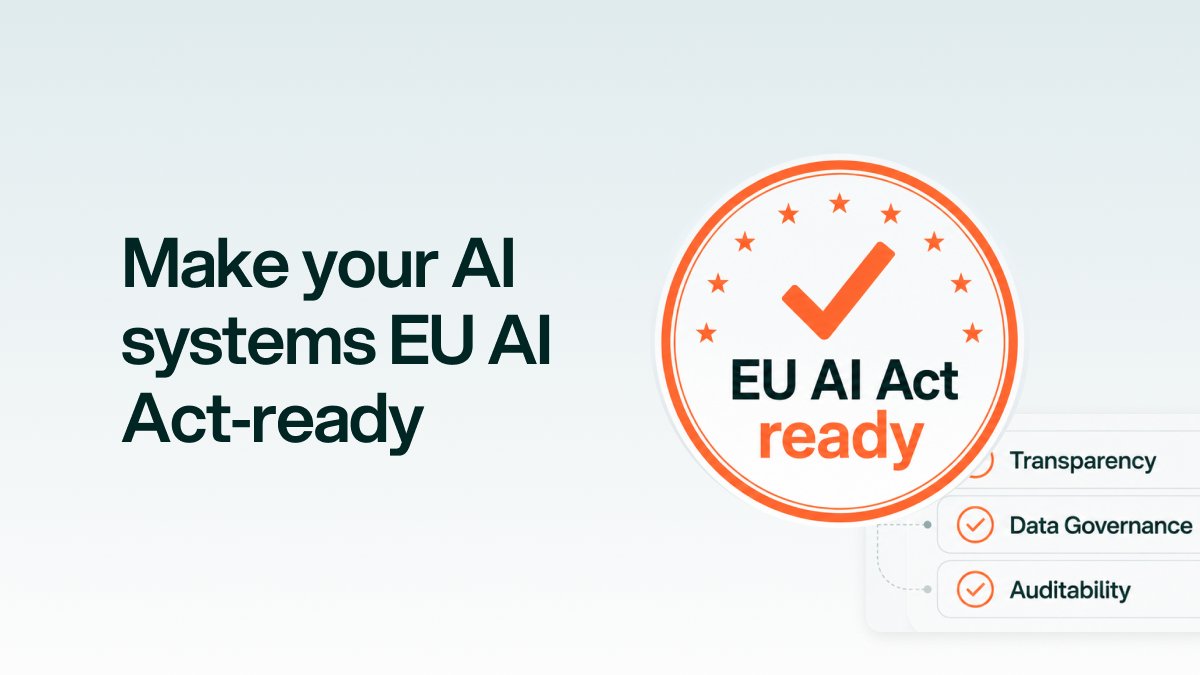
Three things: (1) most enterprise AI use cases are not high-risk — key duties cover transparency, data sovereignty and traceability. (2) Service, sales and production agents with provable citation chains and EU hosting are typically compliant. (3) The decisive factor is platform architecture — audit trails and governance must be built in, not bolted on.
Scope overview
The EU AI Act addresses AI systems by risk class: unacceptable, high, limited, minimal. For manufacturing use cases, maintenance agents, service-hotline support, proposal and product-knowledge agents typically sit in 'limited risk' with transparency and documentation duties. High-risk scenarios emerge when safety-critical decisions are automated without human override.
14-point checklist
- Per-use-case risk classification documented
- Intended purpose and limits in writing
- Training and input data traceably documented
- Transparency notice for users (you are interacting with AI)
- Human oversight embedded
- Error and escalation paths defined
- Citation chain for every answer
- Audit trail retained ≥ 12 months
- Data sovereignty via EU hosting or dedicated tenant
- No customer data used for third-party model training
- DPIA where personal data is involved
- Technical security (ISO 27001, TLS, encryption at rest)
- Robust roles-and-rights management
- Regular quality and fairness reviews
Data sovereignty — what actually matters
EU hosting alone is not enough. What matters: which inference endpoint is actually used, how logging is structured, and whether customer data is used for model training. Clear contractual exclusions and a technical audit trail are mandatory.
How Genow covers this
EU hosting in Frankfurt, Azure OpenAI EU, optional VPC or on-prem deployments, dedicated tenant scope, per-answer citation chain, versioning and rights management in the Context Engine, ISO-27001-compliant operations. For every answer you can trace which sources in which version were used.
At the same time, high-quality results provide employees with optimal support in carrying out their tasks.
Implementation roadmap
1. Inventory all planned AI use cases.
2. Classify risk per use case.
3. Install a governance board (compliance, IT, business).
4. Pick a platform with audit-trail capability (for example, Genow).
5. Policies, training, review cadence.
FAQ
What's the biggest misconception about the EU AI Act?
That every enterprise AI is automatically classified as high-risk. It isn't. Most productive use cases fall under limited risk.
Does the AI Act replace GDPR?
No. Both apply in parallel. The AI Act adds transparency and risk duties.
Do I need a dedicated AI certification?
In most cases, no — documentation, audit trails and governance are sufficient.