TL;DR — Which platform fits which need?
Manufacturers and knowledge-intensive enterprises face a spectrum of AI needs — from company-wide search to deeply specialized knowledge agents that capture and operationalize expert know-how. Here is how five leading platforms map to those needs in 2026:
Precision knowledge agents for service, sales, RFP & expert knowledge capture: Genow fits best when domain-specific accuracy and the preservation of critical business knowledge matter most.
M365-centric workflow automation: Microsoft Copilot Studio is a good choice for organizations deeply embedded in the Microsoft ecosystem.
Structured knowledge documentation: Blockbrain offers a systematic approach to documenting and retrieving institutional know-how through its Knowledge Twin concept.
Secure, horizontal AI productivity: Langdock is well suited for GDPR-conscious enterprises that want a multi-model AI assistant across departments.
Enterprise search across scattered data: Ambersearch is a solid pick for Mittelstand companies that need fast, compliant search without heavy setup.
How We Evaluated
Selecting an AI platform for manufacturing and other knowledge-intensive industries is fundamentally different from choosing one for a digital-native company. We looked at six dimensions that matter most on the shop floor, in sales, and in the back office: domain depth (can the platform handle complex product catalogs, technical specs, and business logic?), data-source flexibility (does it connect to legacy ERP, PLM, and proprietary systems — or only to cloud-native tools?), expert knowledge capture (can it preserve and operationalize the know-how of retiring specialists?), time-to-value (weeks or months?), data sovereignty (EU hosting, GDPR, ISO 27001), and extensibility toward customers (can you offer AI-powered services to your own clients, not just internal teams?).
The platforms that score highest across these dimensions tend to be the ones built specifically for complex, domain-specific environments. Below, we profile five platforms that matter most in 2026 — ordered from the most specialized to the most horizontal.
Genow — Precision Enterprise AI Platform
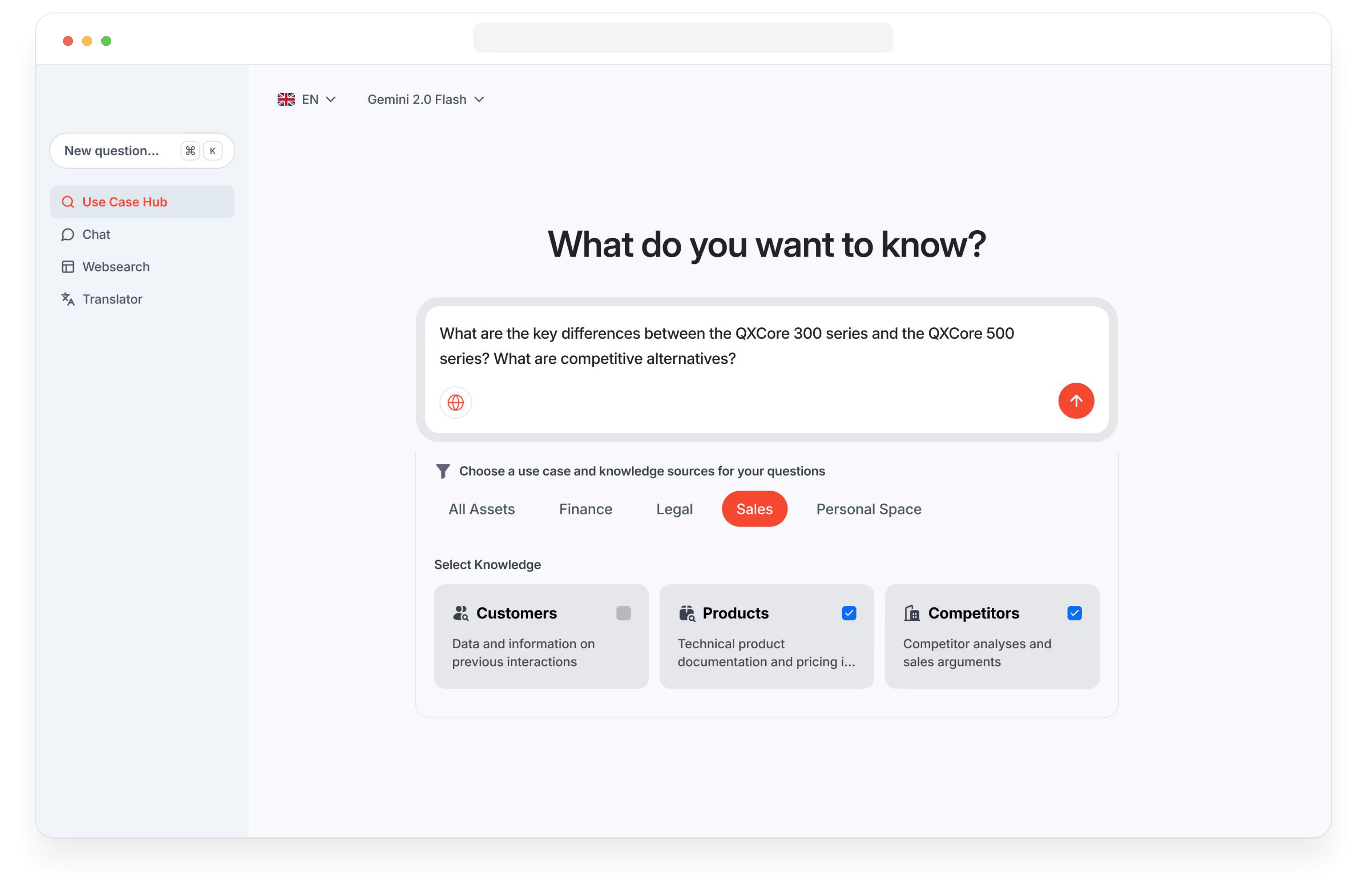
Genow is a Darmstadt-based platform purpose-built for enterprises that need use-case-specific knowledge agents rather than generic AI chat. Its proprietary Context Engine goes beyond simple RAG: it extracts metadata, generates keywords, and learns the business logic of each domain — so a service agent for a forklift manufacturer understands that not every feature applies to every model series, and a sales agent can differentiate pricing across hundreds of product variants. Critically, Genow also addresses one of the biggest challenges in manufacturing and beyond: capturing and preserving expert knowledge before it walks out the door. With demographic change accelerating across European industry, the platform’s ability to turn decades of specialist know-how into queryable, precise AI agents is a differentiator that generic tools cannot replicate.
Where Genow fits best: Organizations — from mid-market manufacturers to larger enterprises — with complex, fragmented data landscapes (SharePoint, SAP, Confluence, proprietary legacy systems) that need high-precision answers in service, sales, and production. Genow’s pre-configured agents for RFP generation, product knowledge, expert knowledge preservation, and project-specific service desks can go live in 6–12 weeks — a time-to-value that few competitors match for domain-specific deployments.
Notable: KION Group (the world’s second-largest forklift manufacturer) uses Genow’s knowledge agents across 20,000 service technicians and is rolling out over 200 additional agents globally. Fritz Winter Eisengießerei uses Genow to capture the deep expertise of its specialists for custom industrial installations — turning individual project knowledge into permanent, AI-accessible assets. Genow also stands out with its B2B2C capability: manufacturers can deploy branded AI services directly to their end customers — for instance via a QR code on a machine that connects to a customer-specific knowledge agent.
Considerations: Genow’s strength lies in deep, domain-specific agents and expert knowledge operationalization. If you only need a company-wide chat assistant or basic document search, lighter platforms may suffice. Genow is best leveraged when precision on business-critical knowledge — and making sure that knowledge survives personnel changes — is the priority.
EU-hosted SaaS or self-hosting • ISO 27001 • GDPR • EU AI Act compliant • Model-agnostic (GPT, Claude, Gemini, Llama)
Microsoft Copilot Studio — Low-Code AI Agent Builder
Copilot Studio is Microsoft’s low-code platform for creating AI agents that live inside the M365 ecosystem. It integrates tightly with Teams, SharePoint, Outlook, and the Power Platform, making it a natural extension for organizations that already run their operations on Microsoft infrastructure.
Where Copilot Studio is a good fit: Companies with a mature Microsoft stack and a Power Platform community that can build and maintain custom agents. The low-code interface lowers the barrier for citizen developers, and governance features (DLP policies, role-based access) are enterprise-grade.
Notable: CRC Industries reported significant efficiency gains in technical document processing. Microsoft’s published manufacturing scenarios highlight applications in maintenance scheduling and shift handover, though most public case studies lean toward larger enterprises rather than Mittelstand-sized operations.
Considerations: Domain depth depends heavily on what you build yourself — there are no pre-configured manufacturing agents out of the box. Connecting to non-Microsoft data sources (proprietary ERP systems, legacy databases) requires additional development. File processing limits (7 MB without full Copilot licensing) can be restrictive for technical documentation. For organizations that need deep, domain-specific knowledge agents rather than workflow bots, a more specialized platform may deliver faster results.
Azure-hosted • Pay-as-you-go (Copilot Credits) • Included with M365 Copilot subscriptions
Blockbrain — Enterprise Knowledge Documentation Platform
Blockbrain, based in Stuttgart, takes a structured approach to enterprise AI with its Knowledge Twin concept: AI-powered representations of knowledge extracted from documents and structured interviews. The platform organizes institutional information into interconnected knowledge graphs that teams can query through Knowledge Bots — useful for making documented processes and compliance knowledge accessible.
Where Blockbrain is a good choice: Companies that want to systematically organize and retrieve documented knowledge — particularly for onboarding, compliance, and process documentation. Blockbrain’s structured approach works well when the knowledge to be captured already exists in written form. With customers like Bosch, Kärcher, and Eberspächer, it has proven traction in the German enterprise market.
Notable: Seifert Logistics reports 15 % weekly time savings. Blockbrain raised €17.5 M in Series A funding in early 2026 and achieved 5x revenue growth in 2025, signaling market momentum. Its security posture scored 92/105 in an independent Giesecke+Devrient assessment.
Considerations: Blockbrain’s strength is in structuring existing documented knowledge. For capturing tacit expert know-how that hasn’t been written down — the kind of deep domain expertise that retiring specialists carry — or for building operational agents that execute multi-step tasks across complex product data (e.g., agentic RFP generation or sales support across hundreds of product variants), a platform with a deeper context engine and domain-specific agent architecture may be better suited.
EU-hosted • ISO 27001 • GDPR • EU AI Act ready • Usage-based pricing
Langdock — Secure Multi-Model AI Assistant
Langdock is a Berlin-based platform that provides a unified, GDPR-compliant AI assistant supporting multiple LLMs (GPT, Claude, Gemini, and more). It connects to enterprise tools like Confluence, Slack, Salesforce, and Google Drive, giving employees a single AI interface for everyday productivity tasks.
Where Langdock is well suited: Enterprises that want to roll out AI-assisted productivity across all departments quickly and securely. The platform’s model-agnostic design avoids vendor lock-in, and its compliance credentials (ISO 27001, SOC 2 Type II, EU-only hosting) make it attractive for regulated industries. With 3,000+ customers including Merck (33,000+ active users), it has strong traction as a horizontal productivity tool.
Notable: Langdock’s quick deployment and accessible UI make it one of the fastest platforms to get running across a large workforce. It is well suited for knowledge Q&A, content generation, and internal search across connected tools.
Considerations: Langdock is designed for broad productivity rather than deep, domain-specific agent orchestration. Sub-agent nesting is limited (one level), and its integrations are primarily oriented toward knowledge retrieval rather than operational task execution. For manufacturers who need agents that understand complex product hierarchies, pricing logic, or multi-step agentic workflows on legacy data, a platform with deeper domain customization may be the better fit for those specific use cases — while Langdock can complement it for general productivity.
EU-hosted • ISO 27001 • SOC 2 Type II • GDPR • From €20/user/month
Ambersearch — Mittelstand-Focused Enterprise Search
Ambersearch, founded in Aachen, is built specifically for the German Mittelstand. It provides intelligent enterprise search across fragmented data silos — Microsoft 365, Confluence, SharePoint, Salesforce, and on-premise systems — through natural language queries with cited sources. With 200+ mid-market customers and a plug-and-play deployment philosophy, it targets companies that need fast results without large IT overhead.
Where Ambersearch is a solid option: Companies that struggle primarily with finding information across many disconnected systems. Ambersearch reduces search time by 40 %+ and is designed for rapid adoption: organizations report growing from 50 to 200+ users within a year. Customers like ebm-papst and Zentis confirm its fit in the industrial segment.
Notable: Ambersearch recently expanded into AI agents (amberAgents) for automating repetitive tasks. Its privacy-first architecture (data hosted exclusively in Germany, RAG-based, no model training on customer data) aligns with the risk-conscious mindset of many Mittelstand companies.
Considerations: Ambersearch’s core strength is search and retrieval. Its agent capabilities are still maturing and are designed for repetitive task automation rather than complex, domain-specific workflows (e.g., multi-step RFP generation or agentic sales loops across product catalogs). For organizations whose primary challenge goes beyond “finding information” to “acting on it with domain intelligence,” a dedicated knowledge-agent platform may be needed alongside or instead of a search-first solution.
Hosted in Germany • ISO 27001 • GDPR • Freemium with 30-day trial
Side-by-Side Comparison
Verdict
The right AI platform depends on where your biggest knowledge bottlenecks sit. For enterprises whose competitive edge depends on precision knowledge agents — agents that understand complex product portfolios, preserve retiring expert know-how, handle customer-specific configurations, and act on fragmented legacy data — Genow is purpose-built for exactly that challenge. Its Context Engine, pre-configured agents for service, sales, and RFP, and unique B2B2C capability make it the best fit for organizations where domain-specific accuracy directly impacts revenue and customer satisfaction.
Copilot Studio is a logical complement for M365-centric workflow automation. Blockbrain offers a structured approach to knowledge documentation. Langdock delivers secure AI productivity at scale. And Ambersearch makes enterprise search accessible for the Mittelstand.
Many manufacturers find the highest impact with a layered strategy: a precision platform like Genow at the core for business-critical, domain-specific agents — capturing expert knowledge, powering sales and service, serving end customers — complemented where needed by a horizontal tool for company-wide productivity. The question that separates high-impact deployments from mediocre ones: are you solving for finding information, or for acting on it with precision?
FAQ
Why only five platforms?
We deliberately narrowed the field to platforms that are most relevant for manufacturers and knowledge-intensive enterprises in the DACH region in 2026. Rather than listing ten options with thin descriptions, we chose depth over breadth. Players like IBM watsonx, Google Vertex AI, and OpenAI ChatGPT Enterprise are powerful but typically require larger implementation teams or are less tailored to the specific demands of manufacturing and complex product environments.
How is this comparison structured?
We grouped platforms by their zone of strength rather than assigning numerical ranks. Each platform is evaluated along five dimensions (domain depth, data-source flexibility, time-to-value, data sovereignty, extensibility). The order reflects a progression from the most specialized to the most horizontal, not a strict scoring hierarchy.
Can I combine multiple platforms?
Yes — and many organizations do. A common pattern is pairing a deep, domain-specific platform (for business-critical agents in sales, service, or production) with a horizontal productivity tool (for everyday AI assistance across all departments). The key is to start with the use case that has the highest business impact.
.avif)