.avif)
From Data Chaos to Clarity
TUDa Spin-off Genow Organizes Knowledge Chaos in Companies
Sara Jourdan, Timo Koppe, Peter Buxmann, and Adrian Glauben (from left to right): Four researchers from TU Darmstadt have founded a deep-tech startup using AI to tackle perhaps the most pressing issue for modern companies: knowledge management. International corporate clients are already sold, and investors are pouring in millions.
Anyone working in a major corporation knows the scene: an important presentation needs to be prepared, but the facts are buried somewhere in SharePoint. Ten folders, a hundred versions, cryptic abbreviations. Even experienced colleagues get lost in the labyrinth. "Twenty to thirty percent of working hours are spent just searching for information," says Sara Jourdan, CEO of Genow. "That translates to millions in losses every single day."
Jourdan knows exactly what she’s talking about. An industrial engineer who studied at TU Darmstadt and in California, she gained initial professional experience at major international corporations and saw firsthand how inefficiently knowledge transfer operates in large organizations. She joined as the fourth member of the founding team at Genow, which was launched in 2023 by Dr. Timo Koppe, Adrian Glauben, and Prof. Dr. Peter Buxmann from the Chair of Software & AI Business. The company promises to fill one of the largest gaps in digitalization: the intelligent utilization of corporate knowledge.
Context Beats Keywords
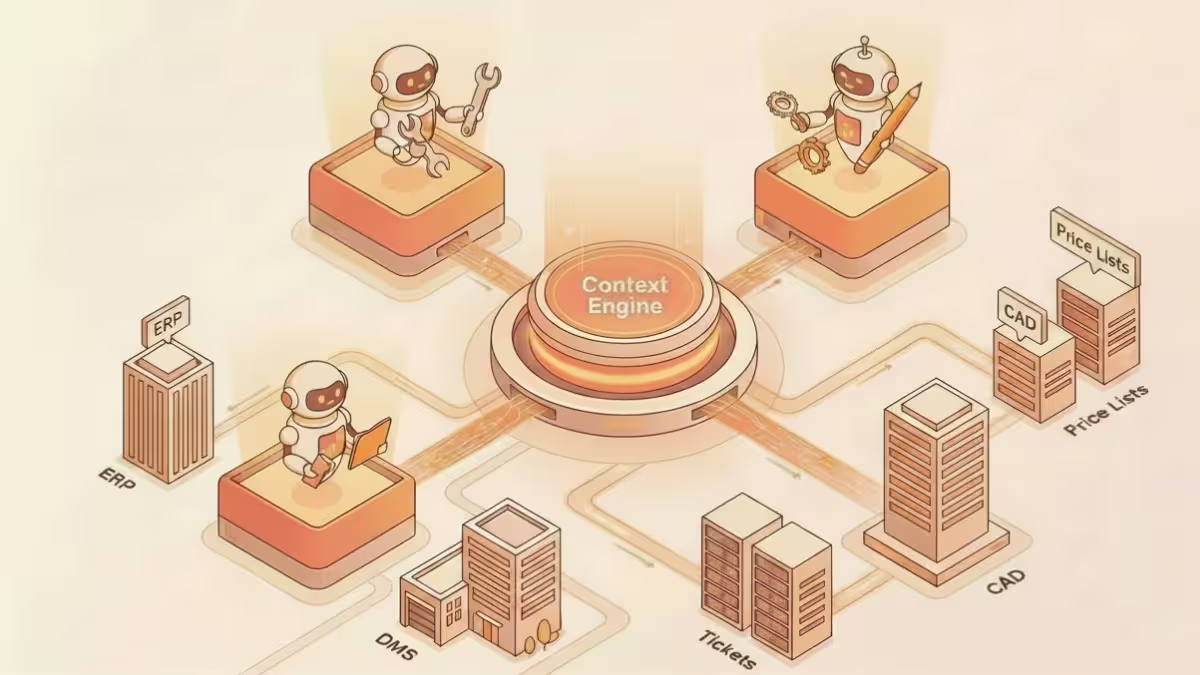
The core of the product: an AI-powered "Knowledge Operations Platform" that merges scattered data sources, understands context, and supports employees as if they had their most experienced colleague right beside them. "We don't provide generic ChatGPT answers," says co-founder Adrian Glauben, "but precise, context-aware information tailored to the specific role and use case within the company."
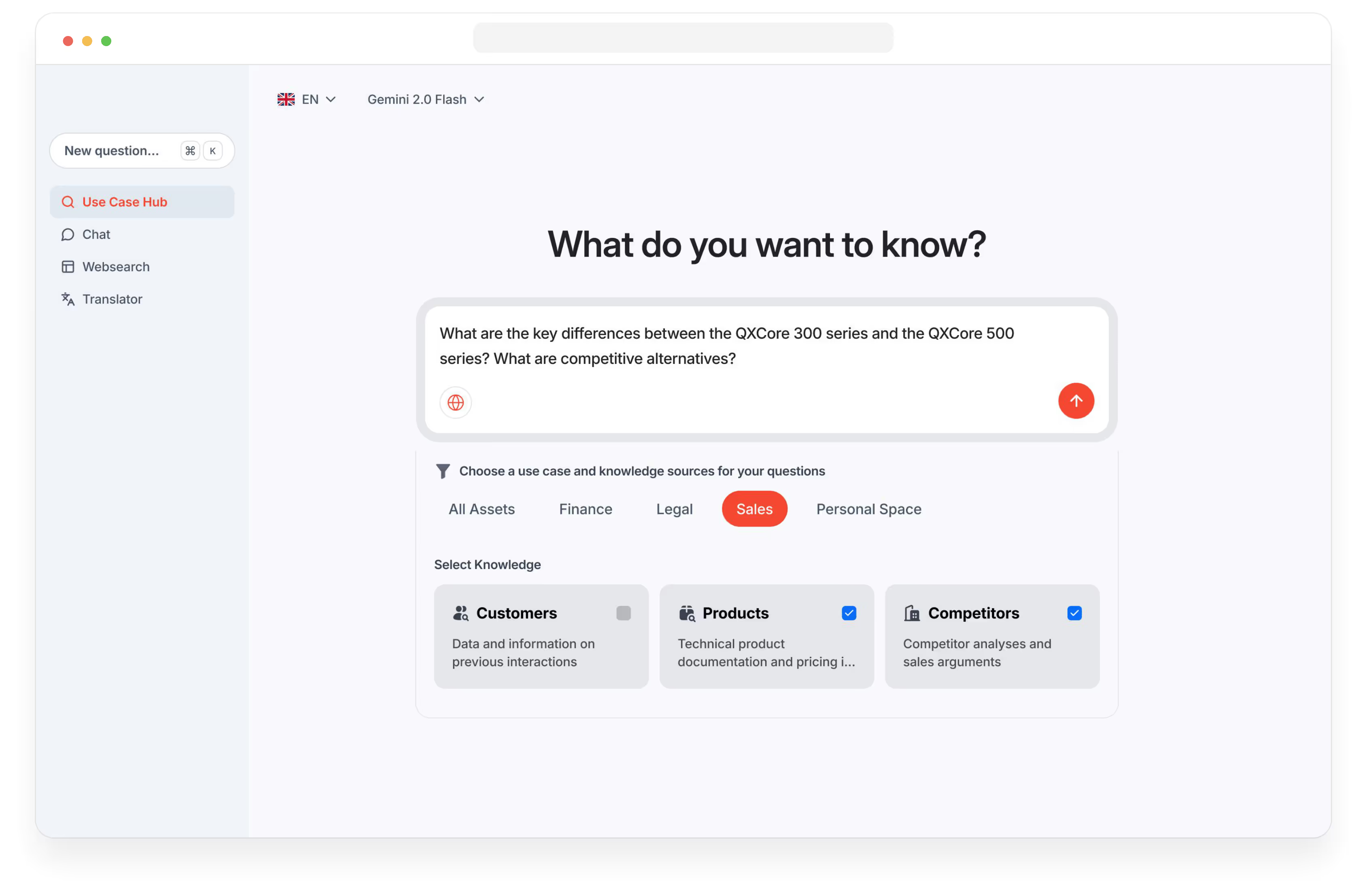
While the technology is complex, the principle is simple: Genow builds specialized knowledge agents for every department and process. In sales, they provide the latest pricing; in HR, they offer current guidelines; in customer service, they grant the fastest access to product information. Everything is GDPR-compliant and hosted within the company’s own cloud environment.
From University to Major Corporation
The idea wasn’t born on the drawing board, but in the middle of the generative AI hype. When ChatGPT dominated the headlines at the end of 2022, major corporations came knocking at the Chair of Information Systems in Darmstadt. They wanted exactly that—but with their own data, not internet knowledge. "Suddenly, we had international corporations as project partners before we were even officially founded," recalls CTO Timo Koppe. "It was both a blessing and a pressure cooker: we had to deliver immediately."
And they delivered. Those initial projects evolved into a platform now used by thousands of employees, including at one of the world's largest forklift manufacturers and a U.S. investment bank. This isn't a lab experiment; it’s in daily operation.
Investors are betting on knowledge management
Investors are also convinced. In August 2025, Genow closed a seed funding round of 1.65 million euros, led by High-Tech Gründerfonds (HTGF) and supported by BMH Hessen and three experienced business angels. "Few teams understand the needs of large corporates as well as this one," says HTGF Investment Manager Felix Assion.
Four Minds, One Mission
What makes Genow special is not just the technology, but the team: Jourdan, the strategist with an industrial background; Koppe, the cloud expert with startup experience; Glauben, the product thinker from AI research; and Buxmann, the mentor, professor, columnist, and serial founder. Four perspectives, one mission.
"Ultimately, it's about efficiency, but also about quality," says Jourdan. "Those who have the right information at the right time make better decisions, provide more personalized advice to customers, and avoid mistakes. That is exactly what we are building Genow for." The ambitions are high: international expansion, developing the platform into an "Agent Suite" for complex workflows, and positioning it as the standard in knowledge management.
In an industry where buzzwords come and go quickly, Genow focuses on substance. "We want to become the SAP of knowledge management," says Adrian Glauben. For now, it is still a young startup from Hesse. But the first steps suggest that something more than just another AI tool is being created here. (Author: Heike Jüngst)
The Interview
IN CONVERSATION with Sara Jourdan, Adrian Glauben, Timo Koppe, and Peter Buxmann
HIGHEST: Ms. Jourdan, Mr. Koppe, Mr. Glauben, Professor Buxmann – how did Genow come to be?
Sara Jourdan: The idea was born out of a real problem. In almost all the large companies I worked for, I experienced how much time and energy is lost through fragmented knowledge. Employees search for information in SharePoint, Confluence, or emails, losing hours and finding different versions of the same file. When we were researching exactly this topic at the Chair of Information Systems at TU Darmstadt and the hype around generative AI emerged at the same time, it was clear to us: there is an opportunity here. We had the knowledge, the problem, and a team.
Timo Koppe: The decisive moment came when we realized: companies don’t want ChatGPT for their Christmas poems; they want it for their own knowledge. They want a platform that handles internal data just as intelligently as ChatGPT handles the internet. Only context-aware, secure, and scalable. That was the starting point for Genow.
Adrian Glauben: We had already been conducting deep research into language models at the institute. The difference was: we understood that it’s not enough to just index documents. Context is crucial—department, role, technical jargon. That was the technical birth of our approach.
Peter Buxmann: As a professor, I see many clever ideas, but only a few that truly become market-ready. Here, I had the feeling from the start: this can work. Not just in the lab, but in practice. That’s why I encouraged the team to take the step and found a startup.
HIGHEST: What distinguishes Genow from classic search engines or chatbots?
Timo Koppe: Most search solutions search documents for keywords. That is 90s technology. We understand content semantically, recognize connections, and deliver answers that take the specific context of the person asking into account. Whether someone works in sales, HR, or compliance—our platform knows this and provides the appropriate answer.
Sara Jourdan: This means: we avoid the typical ChatGPT weakness, which is giving generic answers. Our agents work exclusively with the company's data, and they provide results that are reliable. For a maintenance employee, for example, this means: they don't get just any manual, but exactly the right passage they need at that moment.
Adrian Glauben: Another difference is that we don't just provide answers, but also identify knowledge gaps. The system continuously learns which information is missing and helps to supplement it. This makes an organization's knowledge not only usable but also systematically expanded.
HIGHEST: How did it happen that you won international major customers so early on?
Sara Jourdan: It was a mixture of timing and networking. When the hype around generative AI began, corporations called us at the chair. They had read the headlines and wanted to know: Can we have this for our data? We won two of these companies as project partners directly, even before we had officially founded.
Timo Koppe: That was a stroke of luck. And an enormous amount of pressure. Because the companies didn't expect a finished product in three years, but immediate results. So we built prototypes in weeks, tested them, discarded them, and rebuilt them. That forced us to become market-ready very quickly.
Adrian Glauben: And it opened our eyes: consulting is not enough. In the end, every company wants a platform that it can operate itself. From these projects came the product idea that is Genow today.
HIGHEST: How difficult was the step from a secure university position into startup life?
Adrian Glauben: It was a trade-off. One could have taken a position in industry with a good salary and security. But the chance to build something truly big here might only come once. We knew: the team is right, the timing is right, and the problem is real. That was the deciding factor.
Sara Jourdan: Of course, there were doubts. Family and friends ask: Is this necessary? But for me, it was clear. I had seen in industry how severe the problem is. And I wanted to solve it. The risk felt right to me.
Timo Koppe: We supported each other. Each of us knew it would be hard, but we trusted one another. That was crucial.
Peter Buxmann: I always say: entrepreneurship requires courage, but also realism. You have to take risks, but you have to calculate them. With this team, I had the confidence that they could make it.
HIGHEST: What has been the most difficult moment so far?
Sara Jourdan: The phase where we had to develop the product, serve customers, and convince investors all at the same time—and all without significant resources. You don't get much sleep during that time.
Timo Koppe: Technically, it was the challenge of reliably merging a wide variety of data sources. SharePoint, Confluence, customers' proprietary solutions… every system ticks differently. The fact that we integrated that cleanly was a decisive breakthrough.
Adrian Glauben: For me, it was also the time when we wrestled internally over the product strategy. Everyone had a vision, and we had to bring them together. That cost us some discussions, but it also made us stronger.
.avif)
HIGHEST: Let’s talk about financing: How did the 1.65 million euro seed round come about?
Sara Jourdan: We bootstrapped from the beginning using customer revenue. But at some point, it was clear: if we really want to scale, we need capital. We held talks, and High-Tech Gründerfonds (HTGF) was our preferred partner because they are deeply anchored in the tech ecosystem.
Adrian Glauben: With BMH Hessen, we added a strong regional partner that roots us in our local environment. And the three business angels bring valuable experience and contacts. The consortium fits us perfectly.
Timo Koppe: It was important to us that the investors don't just provide money, but also strategic direction. We found that.
Peter Buxmann: I supported the team during the preparation. A financing round is always a maturation process. You have to sharpen your vision, explain your business model, and prove your market potential. The three of them did an outstanding job of that.
HIGHEST: What will the funds be used for?
Sara Jourdan: In three directions: First, product development. We are working on a new Agent Suite that automates even more complex workflows. Second, sales and marketing. We need to get louder and more visible internationally. And third, team building—developers, customer success, sales.
Timo Koppe: The goal is to move beyond the successful pilot-project character and build a scalable platform for the international market.
HIGHEST: Professor Buxmann, why is supporting startups so important to you?
Peter Buxmann: For me, it is an economic necessity and a personal conviction. Research must not remain in an ivory tower. It must go into practice; it must have an impact. Startups create jobs, drive innovation, and strengthen the business location. And personally, it is a joy to accompany young people on this path. I see it as part of my responsibility as a professor to promote entrepreneurship.
HIGHEST: Where should Genow be in ten years?
Adrian Glauben: Our goal is to become the standard in knowledge management—as self-evident as SAP is for ERP (Note: Enterprise Resource Planning, i.e., integrated software solutions). Every large corporation should run its knowledge agents using Genow.ai.
Sara Jourdan: We want to have an international presence and show that deep tech from Germany can be globally successful.
Timo Koppe: And we want to stay ahead technologically. AI is developing rapidly, and we want to be the ones setting new standards.
Peter Buxmann: My wish is that the next generation of students says: "We want to do it like Genow." Then we would have truly made a difference.
The interview was conducted by Heike Jüngst.