TL;DR
RFP automation in manufacturing means specialized AI agents assist your sales team throughout the proposal process: they read incoming requests for proposal, intelligently retrieve your existing configurations and prior offers, and prepare a well-founded basis for a response within hours. Mid-market manufacturers reduce RFP turnaround time by up to 60% while improving win-rate and margin consistency.
In mid-market machinery and equipment manufacturing, the speed of your proposal often decides multi-million-euro deals. Yet most companies still need three to six weeks to turn around a single RFP. Specifications live across SAP, SharePoint and Teamcenter, prior offers sit in PDF folders, and the most profitable configurations exist in the heads of a few senior salespeople — several of whom are about to retire. This is exactly the gap specialized AI agents close.
This pillar explains, in five steps, how RFP automation actually works, where generic AI tools fall short, what outcomes Genow customers in the Mittelstand and large enterprise see — and how to go from first PoC to a production sales agent in 90 days.
What is RFP automation?
RFP automation is a software-driven process in which an AI agent assists your sales team in handling incoming requests — RFP, RFQ, specification document. The agent parses the document, structures requirements and matches them against your company’s internal knowledge. Based on that match, it suggests configurations, modules, prices and language blocks — enabling sales to reach a solid proposal in hours instead of weeks.
Unlike a template engine, modern RFP automation understands business logic. It knows which modules are compatible, which options were offered to a similar customer two years ago, how your sales team actually phrases value props, and what margin corridors are acceptable. That's the difference between 'AI in sales' and a reliable proposal machine.
Why traditional RFP processes break down
Talk to any sales or service leader and you will hear the same five bottlenecks:
- Versioning chaos: Specs are emailed back and forth, alongside Excel pricing add-ons and SharePoint templates from 2019. No one knows which version is binding.
- Distributed data sources: Master data in SAP, technical drawings in Teamcenter, sales arguments scattered across CRM notes — a complete research pass costs 6 to 12 hours per RFP.
- Tribal knowledge: Best-in-class configurations are known to three or five senior reps. Each retirement quietly removes a chunk of institutional know-how.
- Inconsistent tone and margins: Each rep writes differently, each region prices differently. Comparable offers vary by hundreds of basis points.
- High-frequency spec updates: Customer specs change mid-flight on large deals — and the entire proposal has to be reconsolidated.
Generic AI assistants like ChatGPT Enterprise or Microsoft Copilot only address the surface. They write nice paragraphs but understand neither configuration logic nor your portfolio hierarchy. The result: pretty text that does not hold up technically.
How a specialized RFP agent works
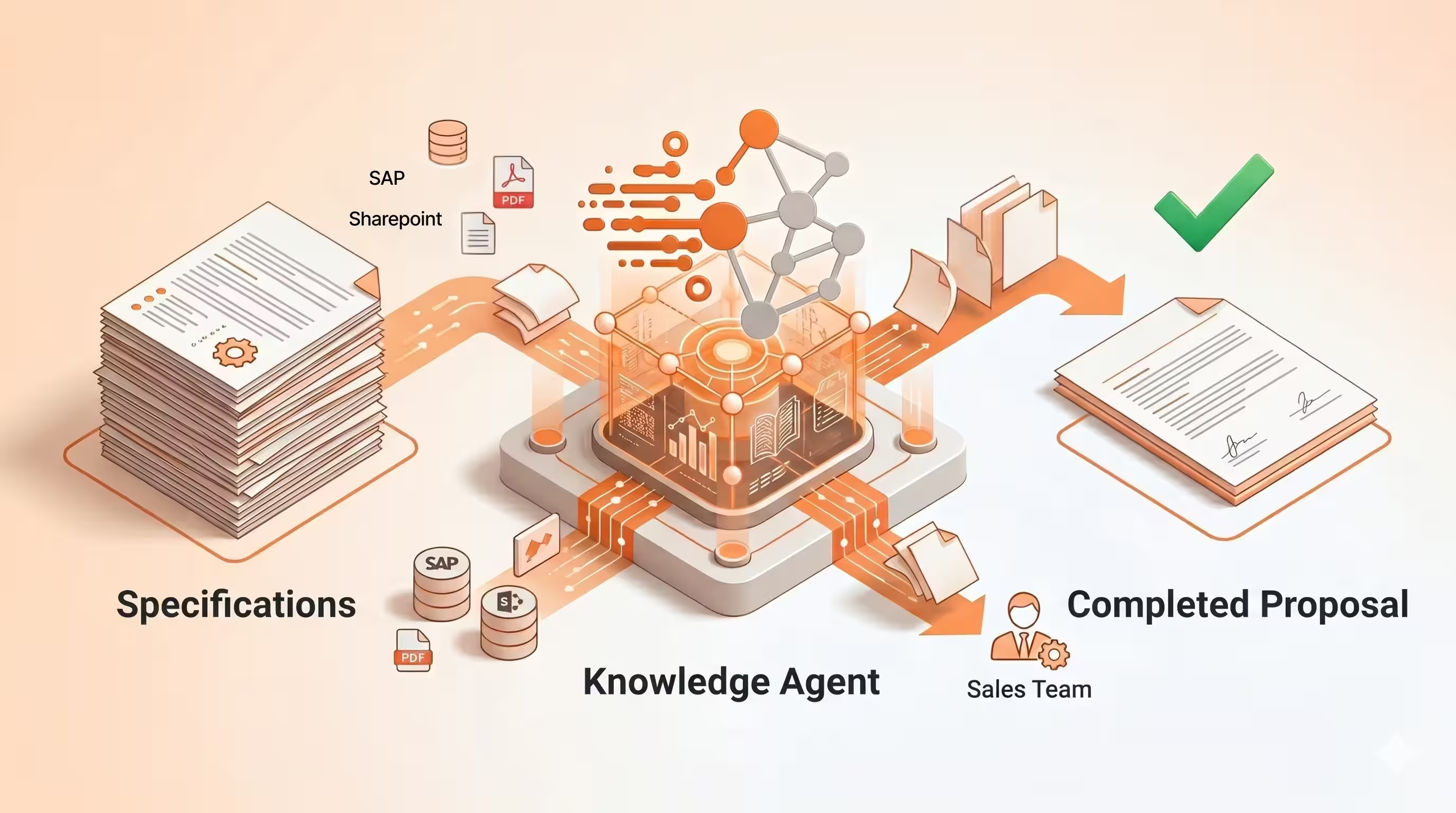
A specialized RFP agent combines four building blocks. At the center sits the Context Engine — the component Genow tunes per company and per use case.
- Data connectivity: Native connectors to SAP, Salesforce, HubSpot, SharePoint, Teamcenter, Confluence and Google Drive — plus flexible bridges to legacy systems and homegrown databases via Genow Connect. [LINK → /integrations]
- Context Engine: Extracts metadata, generates keywords, learns glossaries, product hierarchies, tonality and feedback signals. The reason Genow does not hallucinate.
- Knowledge Agent: Decomposes an incoming RFP into sub-tasks (read spec → find similar prior offers → derive compatible modules → check pricing band → generate response text) with transparent multi-step reasoning.
- Output and feedback layer: Delivers structured results that fit seamlessly into existing sales workflows — with source citations down to the page and paragraph. Reps give feedback on every step, and the agent improves with every RFP.
In one sentence: an RFP agent researches like a senior rep, writes like your best proposal of the past two years, and never produces an answer it cannot back up with a source.
Architecture: connecting SAP, Teamcenter, SharePoint and legacy
In most mid-market projects, the relevant data lives in at least three systems — plus a few PDFs from the early 2000s. RFP automation only works if it accepts that reality instead of trying to replace it.
Proven sequence: start with SAP master data and CPQ logic, add SharePoint/Confluence for specs and whitepapers, ingest historical proposals (often PDF/DOCX in sales drives) in parallel, then connect PLM/Teamcenter for drawings and compatibility rules. Genow runs EU-hosted or self-hosted in your own cloud — GDPR- and EU AI Act-compliant, with no model training on your data.
Generic AI vs. a specialized RFP agent
What measurably improves: numbers from Genow projects
Three examples of what RFP automation looks like in industrial environments:
- International intralogistics group (40,000+ employees; multiple brands in industrial trucks and supply-chain automation): With Genow’s RFP Agent, proposals are produced 2× faster, sales interactions per rep increase, and more deals reach close — all with the same headcount.
- Mid-market custom machinery builder The RFP agent helps the sales team shorten proposal cycles significantly and lays the groundwork for QR-code-based knowledge access on the machine itself — a seamless bridge from sale to service touchpoint.
- German industrial machinery manufacturer: A specialized RFP knowledge agent reduces turnaround and increases proposal quality by leveraging proven configurations — measurable lift in sales efficiency.
Across industries we typically see 50 to 60 percent reduction in handling time. The biggest lever is almost always research time, not the writing itself.
Implementation: from PoC to production agent in 90 days
- Weeks 1–3 — Use case scoping and data hookup. Two or three real RFPs and 30–50 historical proposals are loaded into Genow. First SAP/SharePoint connectors stand.
- Weeks 4–6 — PoC with key users. Three to five senior reps work the agent in parallel and provide structured feedback. First KPIs (turnaround, source quality) are measured.
- Weeks 7–10 — Pilot in one business unit. The agent goes live in a region or product line. Governance, roles, escalation paths and trust setup are locked down.
- Weeks 11–13 — Scale-up and feedback loop. Rollout to additional regions/product lines, CPQ and CRM integration, monthly quality and ROI reviews.
We recommend running a small 'context council' of two senior reps and one IT lead in parallel. They own glossaries, margin rules and tone templates so the agent keeps improving.
Want to see what your own RFP agent would look like?
In a 30-minute live demo we walk you through Genow's Sales Agent on a real spec from your industry. Book a demo.
GDPR, EU AI Act and data sovereignty
RFPs routinely contain sensitive design details, margin calculations and customer data. Genow runs EU-hosted or fully inside your own cloud, is ISO 27001 certified, GDPR-compliant and prepared for the EU AI Act. There is no model training on your data, and document-level permissions are inherited end-to-end. [LINK → /platform/use-case-hub] More on the architecture.
Frequently asked questions
How long does a traditional RFP process take in manufacturing?
For complex deals, three to six weeks is typical, driven mostly by distributed data and manual configuration alignment. With a specialized RFP agent the work shifts from researching to validating — typical reduction is 50 to 60 percent.
Is AI-supported proposal generation GDPR-compliant?
Yes, provided the vendor offers EU hosting or self-hosting, does not train on your data, and inherits access rights cleanly. Genow meets these criteria out of the box, is ISO 27001-certified and EU AI Act-ready.
How does an RFP agent differ from Microsoft Copilot Studio?
Copilot Studio is deeply embedded in the Microsoft ecosystem and ships generic out-of-the-box quality. A specialized Genow RFP agent can be tuned per use case, connects to any third-party system, can deliver AI-powered knowledge access directly to your end customers (e.g. via customer portals or QR codes on machinery), and provides deeper analytics on knowledge quality.
Do we need CPQ before introducing RFP automation?
No. Many mid-market manufacturers start without CPQ and run the agent stand-alone against SAP/SharePoint/Confluence. Adding CPQ later amplifies the impact but is not a prerequisite.
How do we measure ROI?
Four KPIs are enough: average turnaround per RFP, win-rate, margin variance across comparable proposals, and handling hours per RFP. Typical results: turnaround −50 to −60%, win-rate +5 to +10 points, margin variance halved.
Can we make the agent available to our customers?
Yes. Genow can deliver the agent inside customer portals, a dedicated hub or directly via a QR code on the machine — a capability internal-only platforms like Copilot Studio cannot match structurally.
How to get started
If you want to see what an RFP agent would look like in your sales organization, share a spec (or an anonymized example) and we will build a working proof-of-concept within two weeks. Book a 30-minute discovery — we'll show the Sales Agent live on your own data.