TL;DR — What are AI knowledge agents?
AI knowledge agents are domain-tuned software agents that work across a vast, heterogeneous landscape of validated data sources to help users answer their questions and leverage their knowledge with highest precision — whether for technical service queries, proposal generation or product-knowledge look-ups. They beat generic chatbots on any task where reproducible precision matters.
Why generic chatbots fail in mid-market manufacturing
Generic LLM chatbots return plausible but often wrong answers once questions become domain-specific. For manufacturers that is unacceptable. A service engineer with a wrong voltage spec drives out in vain. A sales rep quoting a hallucinated product spec loses the deal. AI knowledge agents fix the problem by navigating across a heterogeneous landscape of ERP, CRM, DMS, ticketing systems, price lists and technical documentation, generating answers exclusively from validated sources and flagging uncertainty explicitly.
Architecture of a knowledge agent
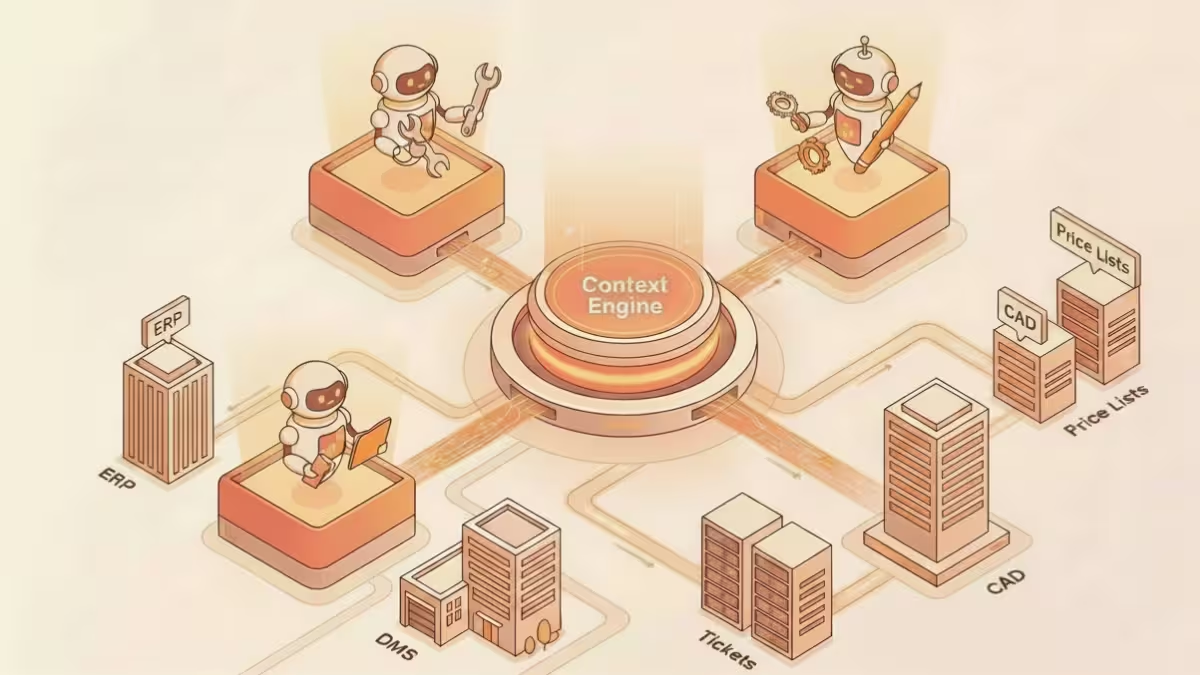
A production-grade knowledge agent has four layers: data integration, context engine, skill layer and interaction layer. The data layer extracts content from a heterogeneous landscape of data sources — ERP, CRM, DMS, ticketing, CAD vaults, price lists and PDF archives. The context engine structures that content, tags it with metadata and citations, and keeps it versioned. The skill layer bundles prompts and tools for the specific business task. The interaction layer delivers the agent where users work — in CRM, in the ticketing tool, in Teams, via API.
The three highest-impact knowledge agent types
Service agent
Offloads the technical hotline by unifying manuals, ticket history and maintenance documents. Typical impact: 30–45% fewer level-2 escalations and significantly shorter resolution times.
Product knowledge agent
Gives sales and service real-time access to datasheets, variants, certificates and compatibility matrices. Typical impact: proposals ship two to three days earlier, cross-sell rate up 8–12%.
Proposal / RFP agent
Automates up to 80% of bid work: analyse specifications, pull reference offers, draft the response, run compliance checks. For mid-market manufacturers typically 15–25% more opportunities processed per month.
Roll-out model — 90 days to the first productive agent
Week 1–2: fix the use case with clear KPIs, stakeholder map, data-source audit.
Week 3–6: data integration, first indexing, retrieval tuning, prompt and skill design with the business.
Week 7–10: pilot with 10–20 users, iterative quality loops, governance integration.
Week 11–13: roll-out to the target audience, training, hand-over to operations, success review.
Success metrics that matter
Precision against domain gold standard ≥ 92%. Answer time under two seconds at the 95th percentile. Every answer cited. Adoption in the business unit above 60% after 60 days. At least one quantified business KPI per use case (handling time, conversion, downtime).
Real-world example: knowledge agents for sales and service at a global industrial company
A global industrial company with a broad product portfolio deployed AI knowledge agents for sales and service. In service, technicians use the agent to quickly look up error codes, spare-part lists and repair manuals — navigating across a heterogeneous landscape of technical handbooks, ticket histories and maintenance documentation. In sales, the agent searches product knowledge, customer-options databases and price lists to find the right configuration for every enquiry. Result: significantly shorter response times in service and measurably higher proposal quality in sales.
FAQ
How many agents should a company run in parallel?
Start with one lead use case. Once the first agent is productive, subsequent ones build faster on the same platform primitives.
How do specialised agents differ from RAG chatbots?
RAG is one building block. AI knowledge agents additionally bring domain skills, tool-use, precise navigation across heterogeneous data landscapes and governance.
Which data sources are mandatory?
Depends on the use case. Service needs manuals, spare-part lists and tickets, sales needs datasheets, price lists and CRM. The knowledge agent reliably navigates across all connected sources.